Science vs. Speculation: Did Tree Removal Cause the Deadly Mauao Landslide?
By Lions Roar Aotearoa Science & Environment Desk
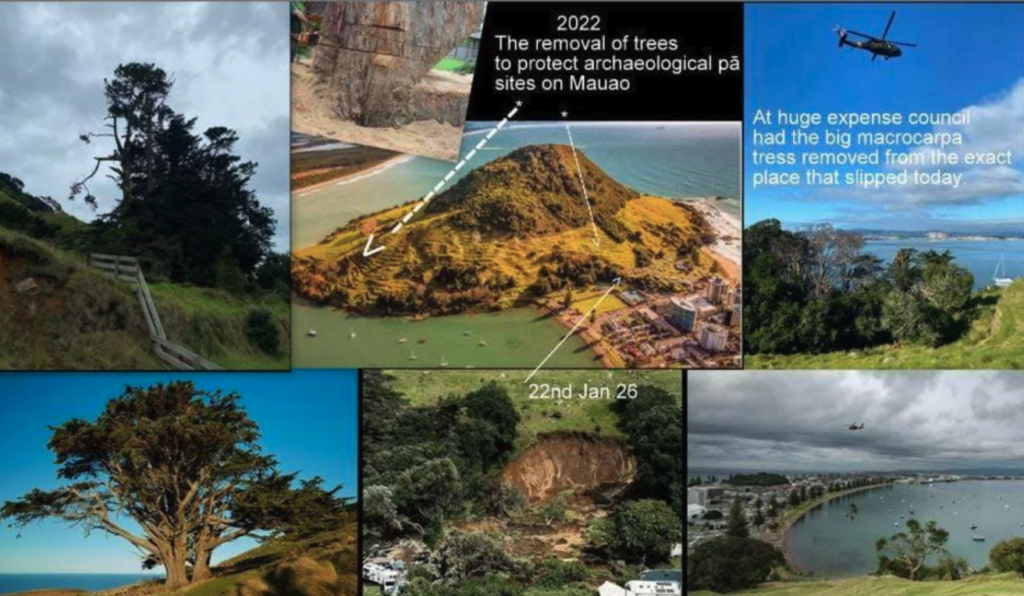
TAURANGA, NEW ZEALAND (Tuesday, January 27, 2026) — As Tauranga mourns the six lives lost in last Thursday’s catastrophic landslide at the Mount Maunganui Beachside Holiday Park, a heated debate has erupted over whether the removal of exotic trees from Mauao in 2022–23 played a role in the disaster.
While social media platforms have been flooded with claims that the clearing of trees weakened the slope, Prime Minister Christopher Luxon has stepped in to condemn the “racist and unhelpful” nature of some posts targeting the Mauao Trust and local council. Now, geological and forestry experts are weighing in, suggesting the truth is far more complex than a few missing trees.
🌳 The Role of Roots: A Shallow Shield?
Between 2022 and 2023, several large exotic trees were removed from Mauao to protect archaeological sites and allow native vegetation to flourish. Critics argue this left the soil vulnerable.
- The Expert View: Dr. Andrew Stolte, a senior lecturer at the University of Auckland, explains that while tree roots are excellent at stabilizing “near-surface” soil and preventing minor erosion, they have limits.
- The Verdict: Stolte suggests it is unlikely the removals were the primary trigger. “Tree roots may not be deep enough to control a deep, fast-moving slip like this,” he says. “It’s not like these trees were removed and the landslide happened immediately. It’s a lot of factors adding up.”
🌧️ The Power of Water: A “Big Driver”
Geologists point to the “unprecedented rainfall” experienced last week as the far more likely culprit.
- Soil Strength: Heavy rain saturates the soil, significantly increasing its weight while simultaneously reducing its “shear strength” (the internal friction that holds a slope together).
- Saturation Point: When soil reaches its limit, the internal pressure of the water acts like a lubricant, causing the entire mass to give way regardless of the vegetation on the surface.
🌲 Does Forest Cover Help?
Emeritus Professor Euan Mason from the University of Canterbury acknowledges that mature forests—whether native or exotic—generally reduce landslide risk.
- Documented Benefits: Scientific literature proves that trees on sloping land are better than grass for preventing erosion.
- The “Rainstorm” Factor: However, Mason agrees with Stolte that the sheer volume of the recent storm was the dominant force. “This particular event was caused by a large rainstorm, so I wouldn’t say it’s just because of tree removal.”
📊 Landslide Factors: Speculation vs. Science
| Factor | Public Speculation | Scientific Consensus |
| Tree Removal (22-23) | Believed to be the primary cause. | A minor contributing factor, but not the “trigger.” |
| Rainfall Levels | Often overlooked in social media posts. | Primary Driver. Extreme rain saturated soil to a breaking point. |
| Root Depth | Assumed to hold deep slopes together. | Mostly effective for shallow, surface-level stabilization only. |
| Archaeological Work | Seen by some as “dangerous” interference. | Necessary for site preservation; supported by Iwi and Council. |
⚖️ “Focus on the Facts”
Prime Minister Luxon’s condemnation of the online vitriol highlights the tension between cultural restoration projects and public safety concerns. As the government inquiry moves forward, investigators will look at the long-term geological stability of the Mount, including whether any native replanting efforts had enough time to establish their own root systems before the storm hit.