AOTEAROA 2026: THE BLUEPRINT FOR A NATION IN TRANSITION
By Lions Roar Staff
Auckland, New Zealand – December 2025
As the clock winds down on 2025, New Zealand stands at the precipice of a defining year. 2026 is not merely another turn of the calendar; it represents the culmination of multi-year policy shifts, a radical restructuring of the national workforce, and a pivotal moment for the country’s environmental and sporting identity. From the halls of Parliament in Wellington to the training grounds of the All Blacks, the “Preparation for 2026” is a massive undertaking designed to future-proof the nation against global volatility and domestic challenges.
The Great Talent Reset: Immigration’s New Era
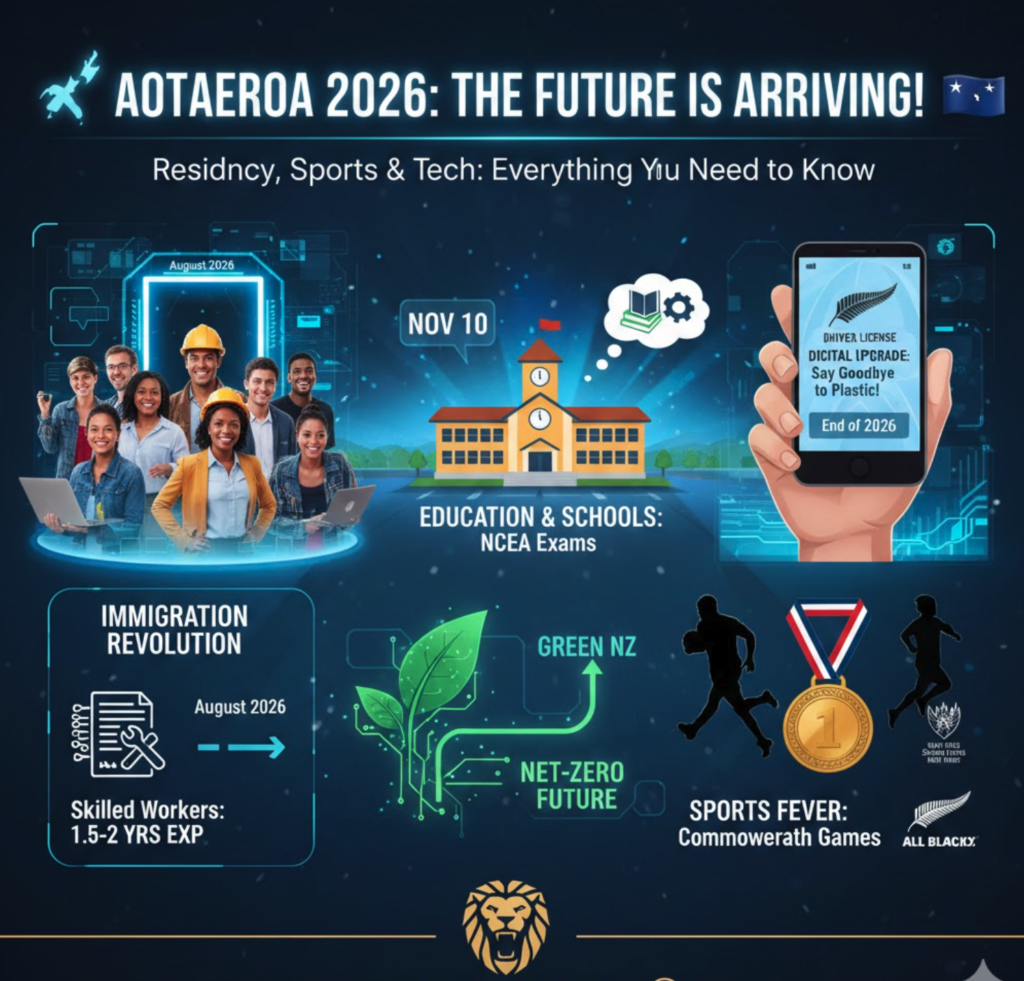
Perhaps the most significant structural change hitting the nation in 2026 is the overhaul of the immigration system. After years of post-pandemic adjustments, the government is set to launch a streamlined residency framework in August 2026. This move is a strategic “talent grab” designed to address chronic labor shortages in critical sectors.
The centerpiece of this reform is the modernization of the Skilled Migrant Category (SMC). New Zealand is moving away from a high-barrier system toward one that rewards longevity and specific vocational expertise. Two primary pathways will open in mid-2026:
- The Skilled Work Experience Pathway: Aimed at professionals in ANZSCO level 1–3 roles. Crucially, the requirement for work experience is being slashed from three years to two years, provided the migrant holds a qualifying role. This is designed to make New Zealand more competitive against Australia and Canada.
- The Trades and Technician Pathway: Recognizing that the “brain gain” must include hands-on labor, this pathway targets tradespeople with Level 4+ qualifications. With only 18 months of domestic work experience required, the government hopes to flood the construction and infrastructure sectors with qualified talent.
Furthermore, the 2026 policy shift addresses the “brain drain” of international students. New rules will grant international graduates faster residency pathways, effectively turning New Zealand’s universities into a permanent pipeline for the local workforce. By easing the wage requirements to the standard median wage, the barrier for entry into the “Team of five million” has never been more accessible for those willing to contribute.
Economic Recovery and the 2026 Business Checklist
Economically, 2026 is projected to be the year New Zealand moves from “recovery” to “expansion.” Economists predict a stabilization of interest rates, which is expected to ignite a surge in Small and Medium Enterprise (SME) investment.
However, business leaders are being warned that the 2026 landscape requires a new playbook. The 2026 Readiness Checklist has become a buzzword in corporate circles, focusing on two main pillars: AI Integration and Generative Succession.
As the “Baby Boomer” generation reaches the peak of its retirement wave in 2026, New Zealand faces a massive “knowledge loss” risk. Preparation efforts throughout the country are focusing on digital transformation—using automation to fill gaps left by a retiring workforce—while simultaneously implementing mentorship programs to transfer institutional knowledge to Gen Z and Millennial leaders.
Educational Evolution: From Classrooms to Careers
The education sector is undergoing its most radical transformation in a generation. In 2026, the Industry Skills Bodies (ISBs) will officially replace the old Workforce Development Councils. This move shifts the power of curriculum design from bureaucrats to industry leaders, ensuring that what students learn in 2026 is directly applicable to the 2027 job market.
For the teaching profession, 2026 marks the debut of Ngā Paerewa 2026. These new standards, issued by the Teaching Council, emphasize a bilingual and bicultural approach to pedagogy, integrating Te Tiriti o Waitangi principles more deeply into daily instruction than ever before.
Even the academic calendar is shifting. The New Zealand Qualifications Authority (NZQA) has confirmed that the 2026 end-of-year examination period will be delayed until November 10. This ten-day extension is a direct response to feedback from educators who argued that the increasing complexity of the new curriculum required more “on-task” learning time for students to achieve NCEA mastery.
The Green Mandate: The Second Emissions Reduction Plan
Environmentally, 2026 is the year the “rubber meets the road.” On January 1, 2026, the Second Emissions Reduction Plan (2026–2030) officially kicks in. This is New Zealand’s legally binding roadmap to hit its 2050 net-zero targets.
The 2026 plan shifts the focus from “consultation” to “compliance.” Expect to see significant subsidies for agricultural technology—specifically methane-reducing feed—and a massive push for renewable energy infrastructure. The government’s goal for 2026 is to decouple economic growth from carbon emissions, proving that a South Pacific nation can lead the world in green exports.
On a more practical level for citizens, the Digital Transformation Initiative aims to have digital driver’s licenses and identity credentials fully integrated by the end of 2026, reducing the need for physical plastic cards and streamlining government interactions.
Politics and Identity: The 2026 General Election
While the next election is months away, the political machinery is already grinding. The Green Party and other major factions have begun overhauling their candidate selection processes. The 2026 election is widely expected to be fought on the “Cost of Quality of Life”—moving beyond the simple “cost of living” to discuss the long-term sustainability of the New Zealand dream.
Sports: A Golden Year for Aotearoa
Finally, 2026 will be a year of immense national pride on the sporting stage. The All Blacks are preparing for a “Grand Slam” style schedule, featuring a high-stakes tour of South Africa and a domestic series against Northern Hemisphere giants France, Italy, and Ireland.
In Glasgow, the Silver Ferns and the rest of the New Zealand contingent are deep in training for the 2026 Commonwealth Games. With a revamped, compact format for the games, New Zealand’s preparation is focused on “high-yield” disciplines like cycling, swimming, and rugby sevens, where the nation expects to dominate the podium.
Conclusion: The Road Ahead
As we look toward 2026, it is clear that New Zealand is not just waiting for the future to happen—it is actively building it. Whether it is through the welcoming of new skilled migrants, the digital revolution in our pockets, or the environmental standards in our fields, Aotearoa is preparing to lead.
For the readers of Lions Roar, the message is clear: 2026 will be a year of high stakes and high rewards. Success will belong to those who are prepared for the transition.
Lions Roar Action Links:
- Stay updated on the latest Immigration New Zealand Policy Changes.
- Check the 2026 NCEA Examination Timetable for your family’s planning.
- Review the Ministry for the Environment’s Emissions Plan for business compliance.