Cyclone Ditwah: World Bank Estimates Direct Damage to Sri Lanka at $4.1 Billion
By Lions Roar News Economic Bureau
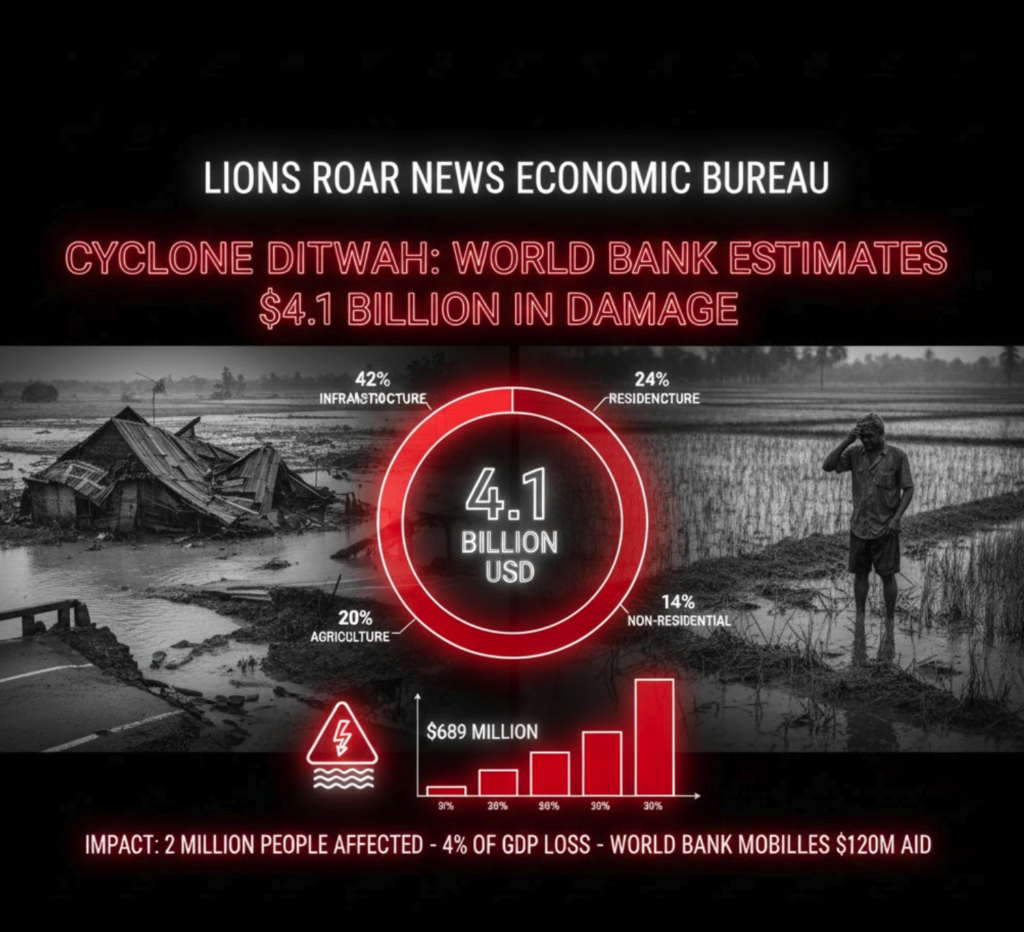
COLOMBO, SRI LANKA (December 22, 2025) – The World Bank Group has released a sobering assessment of the devastation caused by Cyclone Ditwah, estimating the direct physical damage to Sri Lanka at a staggering US$4.1 billion.
According to the Global Rapid Post-Disaster Damage Estimation (GRADE) report published today, the destruction caused by the late-November cyclone is equivalent to approximately 4% of Sri Lanka’s Gross Domestic Product (GDP). The report underscores the massive shock to the national economy, affecting nearly 2 million people and 500,000 families across all 25 districts.
📉 Economic Impact at a Glance
The GRADE report provides a detailed breakdown of how the $4.1 billion in damages is distributed across the country’s vital sectors and regions.
| Category | Estimated Damage (USD) | % of Total Damage |
| Critical Infrastructure | $1.735 Billion | 42% |
| Residential Buildings | $985 Million | 24% |
| Agriculture & Livestock | $814 Million | 20% |
| Non-Residential Buildings | $562 Million | 14% |
| Total Direct Damage | $4.1 Billion | 100% |
🏗️ Infrastructure & Housing: The Hardest Hit
Infrastructure remains the most severely impacted sector, with $1.735 billion in losses. This includes extensive damage to:
- Roads and Bridges: Landslides in the central highlands have severed key transport arteries.
- Railway Networks: Submerged and twisted tracks have paralyzed rail logistics.
- Water & Power: Significant disruptions to water supply systems and telecommunications towers.
The housing sector also suffered a major blow, with $985 million in damages. The World Bank highlighted that the intensity of the storm—one of the most destructive in recent history—highlights the urgent need for climate-resilient housing designs in flood-prone areas.
🌾 Agriculture: A Threat to Food Security
The agricultural sector, the lifeline of the rural economy, incurred $814 million in losses. The cyclone decimated:
- Paddy and Vegetable Crops: Widespread flooding in the “vegetable basket” of the upcountry.
- Commercial Crops: Significant damage to tea, maize, and livestock.
- Inland Fisheries: Infrastructure and equipment losses that threaten the livelihoods of thousands.
This level of destruction raises serious concerns regarding national food security and the potential for rising food inflation in the coming months.
📍 Regional Breakdown: Central Province Hardest Hit
While the cyclone affected every district, the Central Province bore the brunt of the disaster.
- Kandy District: Recorded the highest damage at $689 million, primarily driven by catastrophic flooding and landslides.
- Other High-Impact Zones: Significant losses were also reported in Puttalam ($486m) and Badulla ($379m).
🏛️ World Bank Response
In light of these findings, the World Bank has already mobilized $120 million by repurposing funds from ongoing projects to support emergency recovery and restore essential services like healthcare and water.
“The estimated $4.1 billion in direct damage represents a significant shock,” the report stated. “It does not even include indirect losses such as lost income, production, or the full cost of ‘building back better,’ which will drive the total economic impact even higher.”