Senior Russian General Assassinated in Moscow Car Bombing
By Lions Roar News Foreign Desk
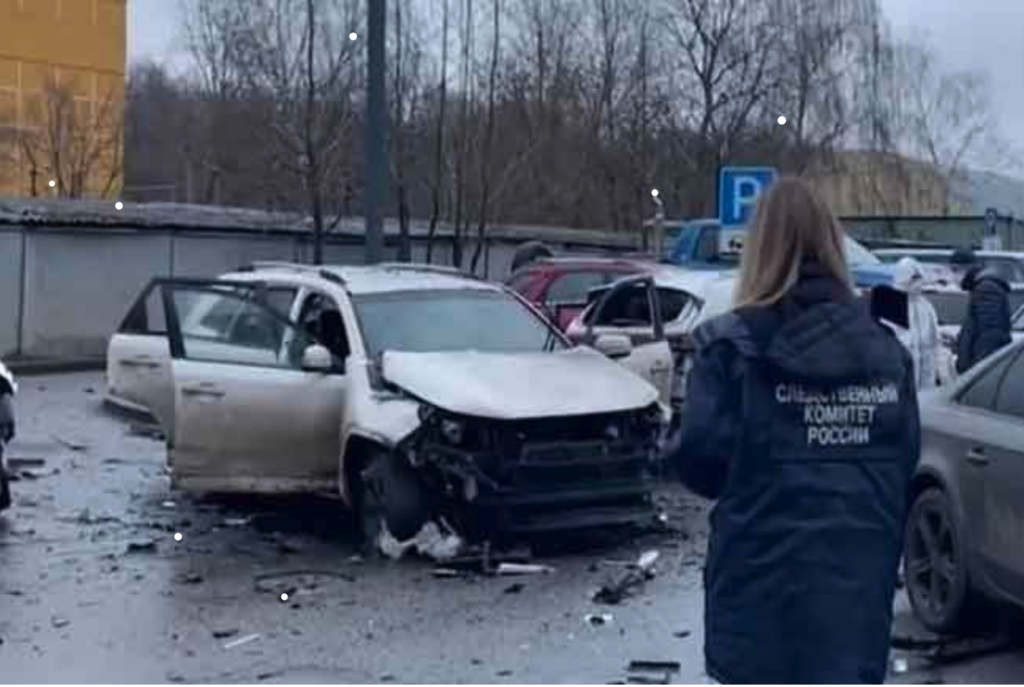
MOSCOW, RUSSIA – In a major breach of security within the Russian capital, a high-ranking military commander has been killed in a targeted car bombing. Lieutenant General Fanil Sarvarov, a key figure in the Russian Armed Forces’ General Staff, was killed early Monday morning, December 22, 2025, when an explosive device detonated beneath his vehicle in southern Moscow.
The Russian Investigative Committee confirmed the death, stating that the blast occurred while the General’s car was parked near a residential apartment complex on Yasenevaya Street. The assassination marks the third high-profile killing of a senior Russian military officer in the capital within the last year, sending shockwaves through the Kremlin’s security apparatus.
💣 Details of the Attack
According to forensic investigators at the scene, the explosive device was meticulously “planted under the chassis” of the General’s vehicle—identified by witnesses as a white SUV. The detonation occurred at approximately 7:00 AM local time, just as Sarvarov was reportedly beginning his morning commute.
Eyewitnesses described a “bone-shaking” explosion that rattled windows in nearby apartment blocks and left a mangled, charred frame where the vehicle once stood.
“We absolutely didn’t expect it. We thought we were safe, and then this happens right next to us,” Tatiana, a 74-year-old local resident, told reporters.
General Sarvarov was rushed to a nearby hospital with critical injuries but was pronounced dead shortly after arrival. His assistant, identified as Ilya Polikarpov, was also reportedly killed in the strike.
🎖️ Who was Lieutenant General Fanil Sarvarov?
Lieutenant General Fanil Sarvarov, 56, was a decorated veteran of the Russian military with decades of experience in high-stakes conflict zones. At the time of his death, he served as the Head of the Operational Training Directorate of the General Staff.
In this capacity, Sarvarov was responsible for:
- Combat Readiness: Overseeing the training and preparation of Russian troops currently deployed in the war in Ukraine.
- Strategic Planning: Coordinating large-scale military exercises across the Russian Federation.
- Conflict History: Sarvarov was a veteran of both Chechen Wars in the 1990s and early 2000s and played a pivotal role in organizing Russia’s military intervention in Syria between 2015 and 2016.
His assassination is viewed not only as a personal loss to the military command but as a significant blow to the operational planning of Russian forces.
🏛️ Investigation Points to “Ukrainian Special Services”
The Russian Investigative Committee has launched a full criminal inquiry into the murder. Svetlana Petrenko, a spokesperson for the committee, announced that while they are pursuing multiple leads, a primary theory is that the “crime was orchestrated by Ukrainian intelligence services.”
This attack follows a pattern of targeted liquidations of pro-war figures and military leaders on Russian soil. It comes exactly one year after Lt. Gen. Igor Kirillov was killed by a bomb hidden on an electric scooter, and months after Lt. Gen. Yaroslav Moskalik was killed in a similar car bombing just outside Moscow.
While the Ukrainian government typically maintains a policy of “strategic ambiguity” regarding operations inside Russia, President Volodymyr Zelenskyy has previously warned that Russian commanders “should know where their bomb shelters are.”
📈 Security Blunder or Escalation?
The Kremlin has responded with fury. Spokesperson Dmitry Peskov confirmed that President Vladimir Putin was “immediately informed” of the assassination. Members of the State Duma’s defense committee have called for “swift retribution,” describing the hit as a terrorist act.
The timing of the blast is particularly sensitive, as it coincides with intensifying international efforts to broker a peace deal to end the nearly four-year conflict. Analysts suggest that such high-profile assassinations within Moscow highlight persistent failures in the FSB (Federal Security Service) to protect top-tier military personnel.