Breaking Barriers: Michaela Benthaus Becomes First Wheelchair User to Reach Space
By Lions Roar News Science & Technology Desk
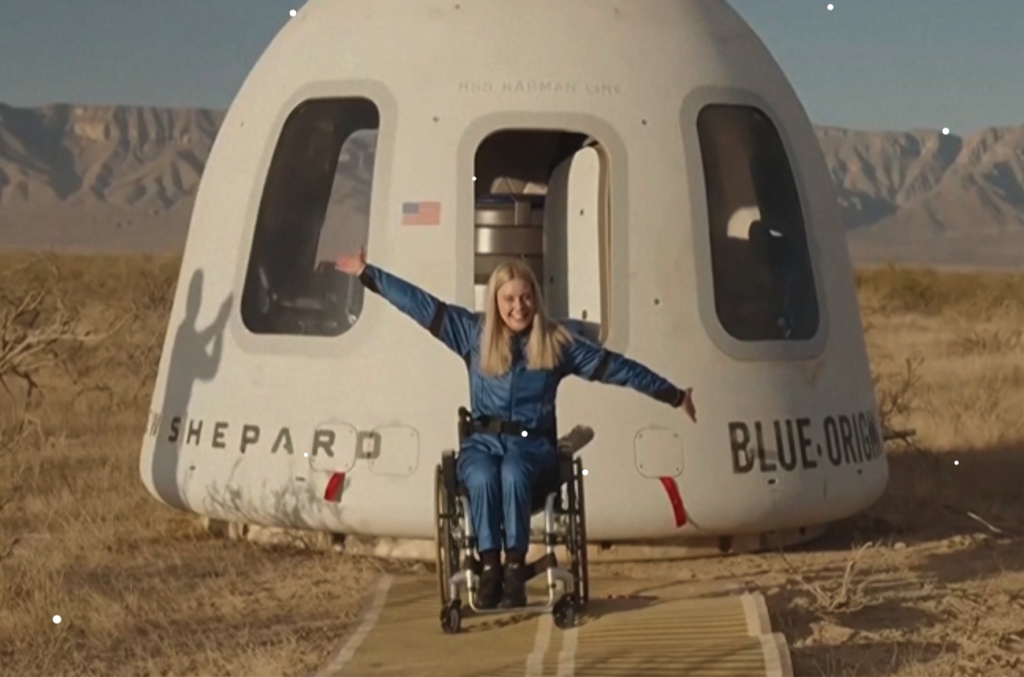
VAN HORN, TEXAS – In a historic leap for inclusivity and human spaceflight, 33-year-old German engineer Michaela “Michi” Benthaus officially became the first wheelchair user to cross the threshold into outer space. On Saturday, December 20, 2025, Benthaus soared past the Kármán Line—the internationally recognized boundary of space—aboard Blue Origin’s New Shepard NS-37 mission.
The 11-minute suborbital flight launched from Blue Origin’s private facility in West Texas, carrying Benthaus and five other crew members into the record books. For Benthaus, an aerospace and mechatronics engineer at the European Space Agency (ESA), the journey was the culmination of a lifelong dream that many thought was lost forever seven years ago.
🏔️ From Tragedy to the Stars
Benthaus’s journey to the stars began with a profound personal challenge. An avid sportswoman and mountain biker, her life took a drastic turn in 2018 following a severe downhill mountain biking accident in Austria. The crash resulted in a spinal cord injury that left her paraplegic and dependent on a wheelchair.
Despite the accident, Benthaus refused to abandon her childhood fascination with space. She pursued her master’s degree in aerospace engineering and eventually reached out to Hans Koenigsmann, a retired SpaceX executive and legendary aerospace engineer.
“I just asked him online… do you think people like me can be astronauts?” Benthaus recalled.
Koenigsmann, inspired by her drive, teamed up with Blue Origin to make the mission a reality. The two eventually flew together as part of the “Out of the Blue” crew.
🛰️ The Flight: 11 Minutes of History
The mission wasn’t just a joyride; it was a proof-of-concept for universal design in space. Blue Origin’s New Shepard system, designed from the outset with accessibility in mind, required only minor adjustments to accommodate Benthaus.
- Seamless Access: Benthaus used a seven-story elevator to reach the launch tower.
- The “Scoot” Board: Inside the capsule, she used a specialized “transfer board” to move independently from her wheelchair into her seat.
- Weightless Freedom: For several minutes at the peak of the 105-kilometer flight, Benthaus experienced total microgravity.”It was the coolest experience! I laughed all the way up. I tried to turn upside down once in space—the feeling of freedom was incredible,” she said after landing.
🏛️ A Message to the World: “Space is for Everyone”
Upon returning to the Texas desert, Benthaus was met with her wheelchair, which had been waiting on a specially unrolled carpet. Her first words to the world were a plea for greater inclusivity, not just in the stars, but on the ground.
“After my accident, I realized how inaccessible our world still is,” she stated. “If we want to be an inclusive society, we should be inclusive in every part—not only in the parts we like to be.”
Her achievement has been lauded by space leaders globally. Jared Isaacman, the Commander of the Polaris Dawn mission and new NASA Chief, congratulated her on X (formerly Twitter), stating: “Congratulations, Michi! You just inspired millions to look up and imagine what is possible.”