Giving with Care: The Legal Truth About “Charity” Donations to Private or Business Accounts during the festive season.
By Lions Roar News Investigative Team
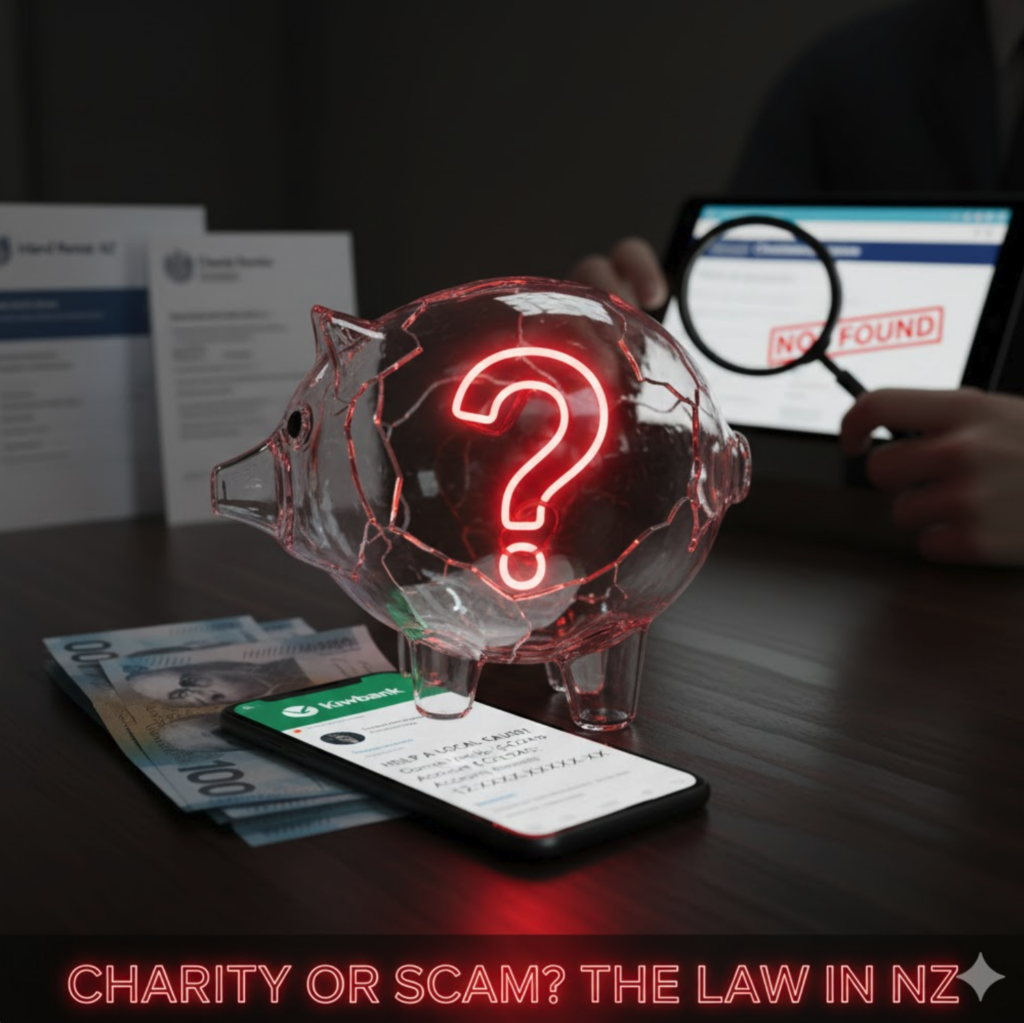
NEW ZEALAND – In an age of social media crowdfunding and viral appeals, the line between a genuine charitable act and a private financial transaction is becoming dangerously blurred. Today, we look at a growing concern across Aotearoa: the legality of collecting “charity” money into personal bank accounts or non-registered business accounts as charities.
If you’ve ever seen a “Help a Local Family” post or a small business soliciting funds for a “cause,” you need to know the risks before you hit ‘send’ on that bank transfer.
🛑 Is it Legal to Collect Charity Money into Personal Accounts?
Technically, there is no law in New Zealand that forbids you from giving your own money to an individual or a private company. However, the moment that person claims to be a “charity” or a “non-profit,” a complex web of legalities kicks in.
The Distinction: Registered vs. Private
- Registered Charities: Must follow the Charities Act 2005.1 They are overseen by Charities Services, must have a dedicated bank account in the charity’s name, and are strictly forbidden from providing “private pecuniary profit” (personal financial gain) to their members.2
- Individuals/Private Businesses: If a person collects money into their personal account for a “good cause,” they are not a charity in the eyes of the law. They are simply an individual receiving gifts.
The Red Flag: If someone asks for donations to a private account but uses a “CC” registration number that doesn’t belong to them, or falsely claims to be a “registered charity,” they are committing an offence.3
⚖️ The Legality and the “Gift” Trap
When you send money to a personal or non-charity business account, the law treats it as an unconditional gift, not a charitable donation. This has major consequences:
- No Tax Credits: You cannot claim a 33% tax rebate from the IRD. Only donations to “Donee Organisations” (usually registered charities) qualify.4
- No Financial Oversight: Personal accounts are not audited by Charities Services. There is no legal guarantee that 100%—or even 1%—of your money actually goes to the intended cause.
- Potential Tax Evasion: For the person receiving the money, if they don’t declare these “donations” correctly, they could be flagged by the IRD for undeclared income or tax fraud.
🚩 How to Report Misuse of Funds
Can you complain if you suspect someone is misusing money collected for a “charitable purpose”? Yes. If you believe someone is collecting money under false pretenses or using an operational business account to dodge tax while claiming to be a charity, here is how to act:
1. Report to the IRD (Inland Revenue)
If you suspect the person is using a business account to hide income or avoid paying tax on these “donations,” you can file an anonymous report for tax evasion.5
- Form: Use the IR873 form (Anonymous Tax Evasion/Fraud Report).6
- Why: The IRD investigates cases where business accounts are used to process funds that aren’t properly declared as either gifts or business income.
2. Report to Charities Services
If the person is claiming to be a registered charity but asking for money to be sent to a personal account:
- Contact: Email [email protected].7
- Why: Falsely claiming to be a registered charity is an offence under the Charities Act 2005.8
3. Report to the Police / SFO
If you have evidence that the money was obtained via deliberate deception (e.g., a fake sob story or a non-existent sick relative), this is fraud.
- Action: Contact your local police or report serious, complex fraud to the Serious Fraud Office (SFO).
🛡️ Consumer Checklist: Before You Donate
| Check This | Why It Matters |
| Is there a CC number? | Check it on the Charities Register. If it doesn’t match the name, walk away. |
| Is the account name private? | Never send “charity” money to an account named “John Smith” or “ABC Trading Ltd.” |
| Is it a “Donee”? | Check the IRD website to see if the organisation has “Donee Status” so you can get your tax back. |