Gold Fever vs. Red Tape: Santana Minerals Pushes for Speed on $5.8B Otago Mine
By Lions Roar News Investigative Team
CROMWELL, CENTRAL OTAGO – The race for New Zealand’s biggest gold find in 40 years has hit a procedural wall, sparking a tense standoff between Australian mining giant Santana Minerals and the Government’s own Fast-Track panel.
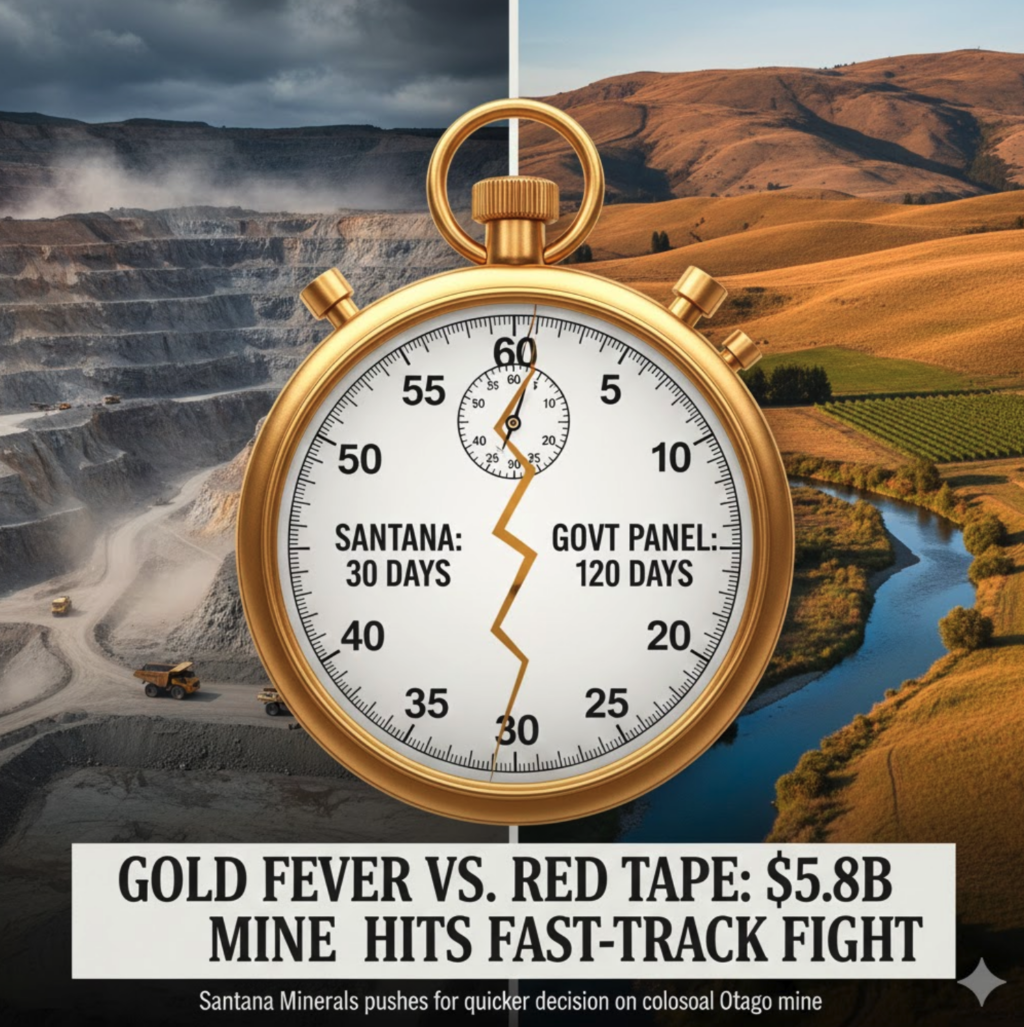
Santana Minerals is formally pushing back against a proposed timeline that could see a decision on its massive Bendigo-Ophir Gold Project delayed until September 2026. The company, which seeks to tap into a deposit worth an estimated $4.4 billion to $5.8 billion, argues that the proposed “slow lane” undermines the very purpose of the Fast-Track Approvals Act.
⏱️ The 30-Day Standoff: Efficiency or Oversight?
The conflict centers on the “Expert Panel” process. Panel convener and former Environment Court judge Jane Borthwick recently signaled that given the “scale, nature, and complexity” of the 9,400-page application, a decision could take between 110 and 120 working days.
Santana Minerals’ CEO, Damian Spring, has rejected this extension. In a firm response, the company insisted that officials should stick to the 30-working-day default timeframe set out in the legislation.
“Robust applications are meant to support faster, better decisions, not justify extended consideration periods,” Spring told reporters. “Moving away from the statutory timeframes risks undermining the very purpose of a fast-track regime.”
💰 The Prize: $1.8 Billion for the Crown
For the New Zealand Government, the Bendigo-Ophir project represents a massive economic windfall during a period of fiscal tightening.
Economic Projections (Over 14-year Mine Life):
- Total GDP Contribution: Approximately $5.8 billion.
- Government Revenue: $1.8 billion in royalties, corporate taxes, and PAYE.
- Job Creation: An average of 351 direct, high-value jobs with an average salary of $140,300—more than double the regional average.
- Infrastructure: Over $530 million in initial capital investment into the Otago region.
Resources Minister Shane Jones has championed the project as a cornerstone of a new “Golden Era” for New Zealand mining, arguing that the country can no longer afford to leave such massive wealth in the ground.
🏔️ “A Toxic Legacy”: The High-Profile Backlash
While the numbers are staggering, the environmental costs are being labeled as “unacceptable” by a growing coalition of critics. Hollywood icon and Central Otago local Sir Sam Neill has joined the fray, warning that the mine will leave a “horrible, toxic thing” for future generations.
“The last thing you should do with a mine that will have serious ramifications for our area for hundreds of years is be fast-tracked,” Neill said. “It’s an Australian company which has never dug a mine before, but our children will be stuck with this.”
The Environmental Risks:
- The “Rise and Shine” Pit: A massive open-cast pit measuring 1000m x 850m and 200m deep.
- The Tailings Dam: A structure made of waste rock rubble that critics claim will be higher than the Clyde Dam, sparking fears of arsenic and cyanide leaching into local waterways.
- Landscape Impact: The project sits on what is designated an “Outstanding Natural Landscape” in the Dunstan Mountains.
Sustainable Tarras, the local advocacy group, called the referral to the fast-track process a “sad day for the environment,” claiming the community has been “locked out” of the decision-making process.
⚖️ The “Rigour” Debate
Santana Minerals maintains that their application is the most thorough in New Zealand history. CEO Damian Spring pointed out that the company has spent over $8 million on baseline scientific and technical work to ensure “environmental stewardship.”
“I have permitted projects under the RMA in the past,” Spring stated. “I can assure you that the process under the Fast-Track regime is of equal or greater substance and rigour.”
The expert panel now faces a difficult choice: yield to the company’s demand for speed to prove the legislation “works,” or take the extra months to scrutinize a project that will physically alter the Central Otago landscape forever.
🔭 What’s Next?
The panel convener is currently finalizing the makeup of the expert panel. If Santana’s push for speed is ignored, the “February start” and “September decision” will stand. However, if the panel is pressured into a 30-day window, a decision could come as early as the first quarter of 2026.
Construction is currently slated for mid-2026, with the first gold target set for 2027.