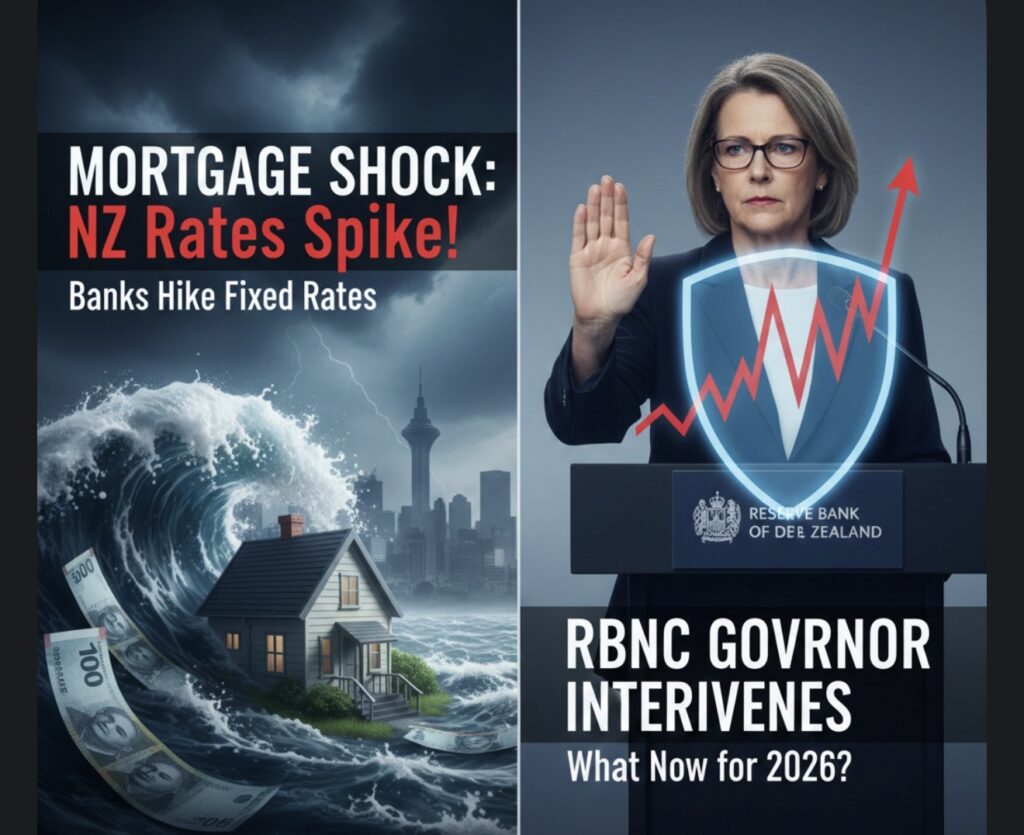
RISING TIDE: Mortgage Rate Hikes Rock NZ Homeowners as RBNZ Governor Intervenes
Screenshot
Auckland, New Zealand – December 15, 2025 – New Zealand’s mortgage landscape has been dramatically reshaped over the past week, leaving homeowners and prospective buyers grappling with the sudden reversal of a recent downward trend in interest rates. A wave of increases across the major banks, targeting medium- to longer-term fixed rates, signals a significant shift in market sentiment, prompting a rare and pointed response from the new Reserve Bank Governor.
The developments have unfolded rapidly, starting with Westpac, followed closely by Kiwibank, and today cemented by ANZ’s broader rate hikes. Concurrently, ASB has reportedly pulled back on the aggressive discounting and ‘specials’ that had become commonplace, further tightening the cost of credit. This coordinated movement among the Big Four banks has collectively rattled the market, suggesting that the era of competitive rate cutting may be over for the foreseeable future.
The Banking Sector’s Sharp U-Turn
The recent flurry of rate changes has primarily focused on the popular two- to five-year fixed-term mortgages, the backbone of many Kiwi household budgets.
Westpac and Kiwibank Lead the Charge
The action began when Westpac hiked its two- to five-year fixed rates by as much as 30 basis points (0.30%). Westpac attributed the increases to “significant increases in wholesale rates,” specifically higher-than-expected movements in the mid- to long-term swap rates. These swap rates, which banks use as a baseline for pricing their fixed-term mortgages, have jumped sharply following the Reserve Bank’s most recent Monetary Policy Statement (MPS). Interestingly, Westpac simultaneously cut its short-term six-month special rate, a move seen by analysts as an attempt to maintain a competitive headline rate while repricing for medium-term wholesale funding costs.
Kiwibank was quick to follow suit, adjusting its own rates upwards, echoing the sentiment of rising wholesale funding costs. This immediate follow-the-leader behaviour suggested that the factors driving the Westpac decision were systemic rather than institution-specific.
ANZ Joins, Broadening the Impact
Today’s announcement by ANZ, New Zealand’s largest mortgage lender, has confirmed the new direction of the market. ANZ’s rate increases were notably broader than its competitors, affecting a wider range of fixed terms. This move locks in the higher pricing structure, leaving fewer options for borrowers who had hoped to secure a lower rate before the year’s end.
ASB Curbs Discounting
In a slightly different but equally significant move, ASB has reportedly become far more stringent with the ‘sharp-end’ discounting that mortgage brokers and existing customers had previously leveraged. While its advertised special rates may not have moved as dramatically as others initially, the effective cost of borrowing has increased due to the withdrawal of negotiation room and reduced special offers. This signals that banks are prioritising margin protection over market share growth in the current climate.
The Reserve Bank Governor’s Intervention
The most compelling aspect of the week’s events has been the extraordinary public statement issued by the new Reserve Bank Governor, Dr. Anna Breman. The rate hikes by commercial banks appear to be a direct market reaction to the RBNZ’s November MPS, where, despite cutting the Official Cash Rate (OCR) by 25 basis points to 2.25%, the central bank provided a surprisingly hawkish signal about the likelihood of further cuts. The market interpreted this as the RBNZ closing the door on more aggressive monetary easing, pushing wholesale rates up.
Dr. Breman’s Response
In a carefully worded statement on Monday afternoon, Dr. Breman addressed the market volatility, stating the RBNZ is “closely monitoring wholesale market interest rates and their effect on households and businesses.” More critically, she acknowledged that market conditions had “tightened beyond what the RBNZ intended.”
The Governor’s intervention is widely interpreted as an attempt to “talk down” the wholesale market, signaling that the bank does not endorse the recent aggressive spike in swap rates. Dr. Breman essentially told the market that its reaction to the November statement was an overcorrection. The implication is that the central bank believes the recent OCR cut should have been more fully reflected in lower retail rates, not an immediate hike in fixed terms.
This firm communication is a powerful tool in a central bank’s arsenal and is aimed at managing inflation expectations and, crucially, stabilising the cost of credit. Dr. Breman’s statement acts as a pressure release, potentially slowing the upward momentum of wholesale rates and, by extension, future retail rate hikes.
Implications for Mortgage Rates in 2026
The recent increases have cast a shadow of uncertainty over the 2026 outlook, forcing a re-evaluation of previous expectations that foresaw a gradual, continued easing of rates.
Short-Term Outlook (Early 2026)
The immediate implication is that the market’s enthusiasm for lower rates has been severely dampened. Borrowers refinancing in the short-term will likely face higher costs than they would have even a month ago. The RBNZ’s intervention may prevent further massive increases, but the new, higher rate floor appears to be set. Borrowers may now be more inclined to select shorter fixed terms (1- or 2-years) in the hope that Dr. Breman’s influence will eventually bring down the mid-term wholesale rates.
Long-Term Outlook (Mid- to Late 2026)
The outlook for late 2026 is now more nuanced and depends entirely on the RBNZ’s next moves and the persistence of inflation.
• RBNZ Forecasts: While the RBNZ’s most recent projection suggested the OCR would remain at 2.25% until mid-2027, the market is now fixated on when the next hike might occur, rather than the next cut. If the economy proves more resilient and inflation remains ‘sticky,’ the timeline for the OCR to return to a more ‘neutral’ level (around 3.00%) could be pulled forward into late 2026.
• The 5.00% Benchmark: Analysts are now suggesting the one-year fixed rate, previously on a trajectory to fall below 5.00%, may now stabilise closer to 5.00% to 5.5% throughout 2026. This revised forecast is a direct consequence of the recent wholesale rate spike and the banks’ protective pricing.
• Borrower Strategies: For homeowners, 2026 will be a year defined by caution. The very little spread between 1-year and 3-year rates makes fixing for longer attractive for certainty, but the immediate rise in these longer terms reduces the appeal. Many are expected to split their mortgages across multiple terms to hedge their bets against a volatile and unpredictable interest rate market.
The recent, dramatic moves by Westpac, Kiwibank, and ANZ, coupled with the new Governor’s immediate need to manage market expectations, underscore the delicate and fragile state of New Zealand’s economic recovery. For the typical Kiwi mortgage holder, the news is a stark reminder that the cost of housing remains firmly under the control of global funding costs and the RBNZ’s fight against inflation.