Crisis on the Street: New Zealand’s Welfare System Leaves the Vulnerable Spiralling, CAB Report Reveals
By Lions Roar News Staff
AUCKLAND/WELLINGTON – A devastating new report from the Citizens Advice Bureau (CAB) has exposed the brutal human cost of recent welfare policy changes in New Zealand, painting a picture of systemic failure that is pushing thousands of vulnerable people—including families with disabled children and the working poor—into impossible situations.
The report, compiled from over 10,000 requests for help, found that government policies—including tightened eligibility for emergency housing, benefit sanctions, and a restrictive approach to discretionary hardship grants—are now actively hindering people’s ability to meet the most fundamental needs: food, shelter, and basic safety.
The CAB’s findings suggest a welfare system increasingly characterized by punitive measures and bureaucratic barriers, rather than compassionate support, leading to profound and often irreversible hardship.
🚨 Losing the Last Safety Net: The Reality of “Welfare that Works”
The most shocking revelations of the CAB report center on the extreme scenarios of deprivation now commonplace across the country. The data indicates that the struggle is no longer confined to traditional low-income groups; people from all walks of life are being caught in financial spirals they cannot escape.
A critical point of failure is the new, more restrictive criteria for assistance, particularly around housing and transport:
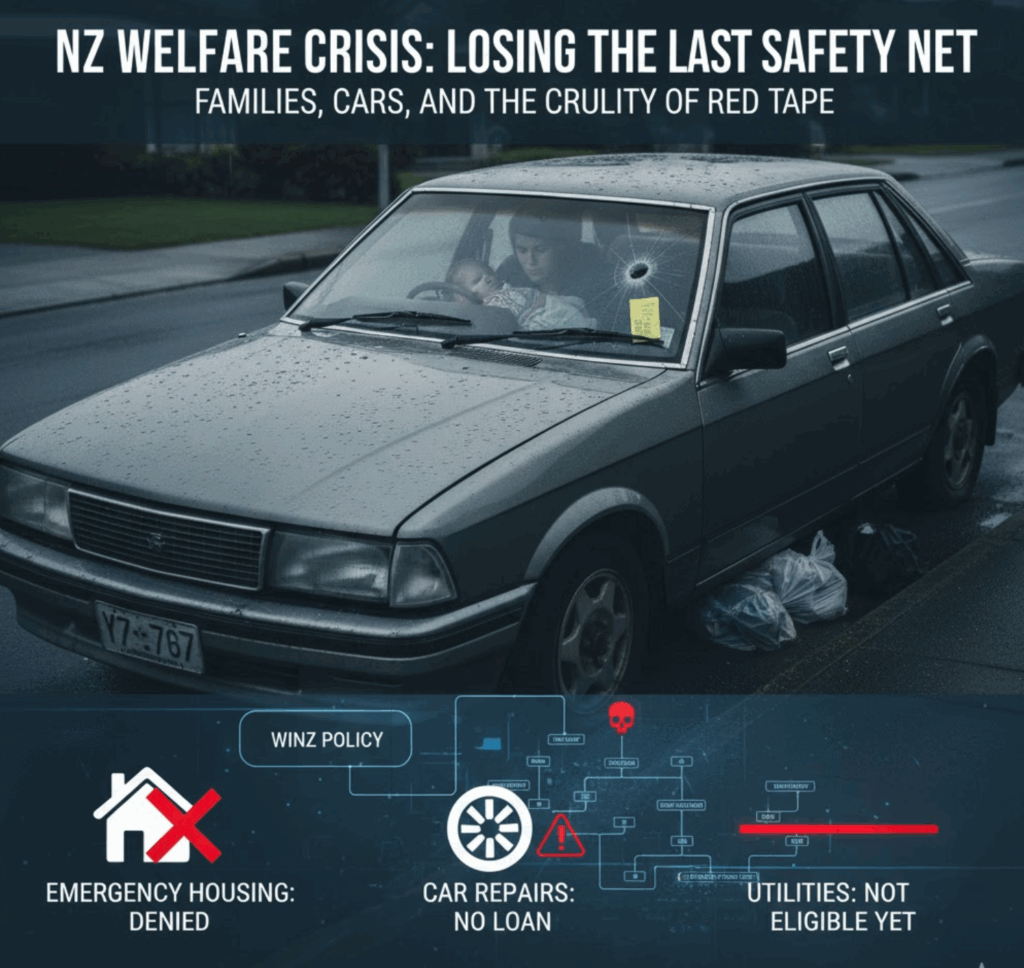
- The Car as a Home: The report highlighted the desperate situation of people who have been forced to live in their vehicles, only to be denied government assistance to make those cars roadworthy. In one case, a woman named Anya was denied a Work and Income loan for car repairs because a new policy restricts funding for vehicle maintenance. Her car is her only home, and she risks fines and seizure because she cannot afford to make it road legal. The punitive cycle is clear: living in the car is an attempt to avoid homelessness, but the state then punishes the act by denying the means to maintain the vehicle legally.
- The “Contributed to Homelessness” Barrier: CAB National Policy Advisor Louise May noted the shocking situation of families, sometimes with young children, facing imminent homelessness who are being told they are “not eligible for emergency accommodation.” This is frequently due to a policy that denies support if a person is deemed to have “contributed to their own homelessness.” This criterion, according to experts, is creating a critical gap in the safety net, forcing families to sleep rough or remain in unsafe living situations. The tightening of Emergency Housing criteria, effective from August 2024, has been designed to make the system more “rules-based” and reduce overall usage, but the CAB report shows the immediate, human consequence of this approach.
Case Study: The Cruelty of “Paying What You Can”
The report details the plight of a father, Tegan, who is spiralling into debt while caring for a disabled child. Tegan faced an unmanageable electricity bill after his landlord refused to fix a broken heat pump in winter, forcing him to rely on an inefficient oil heater.
When Tegan approached Work and Income for help with the bill, he was denied a grant. The reason? Because he was diligently paying what he could to the power company, he was not yet under threat of disconnection, meaning he did not meet the emergency criteria. The solution offered by the agency was financially irresponsible: stop paying his car and contents insurance. This perverse advice effectively asks a client to forfeit basic financial security—insurance against theft, accident, or further home damage—in order to temporarily service a utility bill.
This case exemplifies an operational rigidity that prioritizes bureaucratic boxes over genuine need. As one social welfare advocate stated, “The system is rewarding people for being at the very brink of disaster, but punishing those trying to stay afloat.”
⚙️ The Mechanics of Hardship: Policy and Practice
The CAB report directly links the rise in severe hardship to recent political and administrative shifts, which have been widely reported across New Zealand media:
1. The Focus on Sanctions and Compliance
The current government has made a core commitment to what it calls “Welfare that Works,” including a target of reducing Jobseeker Support recipients by 50,000 by 2030. Key to this strategy is the ramping up of benefit sanctions and a new “Traffic Light” system to track compliance.
While Social Development Minister Louise Upston argues these measures encourage people into employment, independent analysis and now the CAB report suggest they disproportionately punish the most vulnerable who struggle with complex barriers (health issues, disability, or lack of transport/housing stability). Public data shows that while new “non-financial sanctions” (like mandatory community work) are barely used, the number of financial sanctions has sharply increased.
2. The Erosion of Support Services
A consistent issue highlighted by CAB staff is the difficulty clients have in simply accessing the system. The report noted that clients are frustrated by multiple case managers and long waiting times for contact with Work and Income (WINZ).
The CAB is calling for a return to more face-to-face connection between WINZ staff and clients, arguing that a revolving door of case managers and reliance on phone or digital communication prevents the development of rapport and a genuine understanding of complex, interlocking client needs. This administrative friction means that by the time people get help, their situation has already “spiralled” beyond easy repair.
🗣️ The Government Response: Economy Over Empathy?
Social Development Minister Louise Upston responded to the CAB report with a statement acknowledging that “many New Zealanders have been finding things tough” due to “a prolonged cost-of-living challenge.”
Her response reiterated the government’s focus on macro-economic solutions:
- Lowering inflation and interest rates.
- Reducing taxes to “put more money in people’s pockets.”
- Promoting a “growing economy” to create jobs and higher wages.
While these are long-term goals, critics argue the government’s rhetoric fails to acknowledge the immediate, life-threatening hardship faced by those at the very bottom, whose issues are fundamentally structural, not just cyclical.
The Minister confirmed that the Ministry of Social Development (MSD) has committed to meeting with the CAB in the New Year to address “operational issues” raised in the report. However, critics from opposition parties and welfare advocates argue that operational tweaks will not fix what they call a fundamentally punitive policy direction.
The CAB is calling for urgent policy changes, including:
- Prioritizing Food, Housing, and Utility Security: Ensuring basic needs are met before applying sanctions or bureaucratic barriers.
- Reviewing Compliance Penalties: Ensuring penalties are proportionate and do not lead to homelessness or severe deprivation.
The report concludes with a grim warning: the current welfare system is not only failing to support the most vulnerable but is actively expanding the population of those in crisis, seeing more people who would not have previously been considered vulnerable falling into financial holes they cannot get out of. The car keys, and the dignity, of struggling New Zealanders are literally being put at risk.