Catastrophe Unfolds: Sri Lanka’s Death Toll Skyrockets to 465 in Aftermath of Devastating Cyclone Ditwah
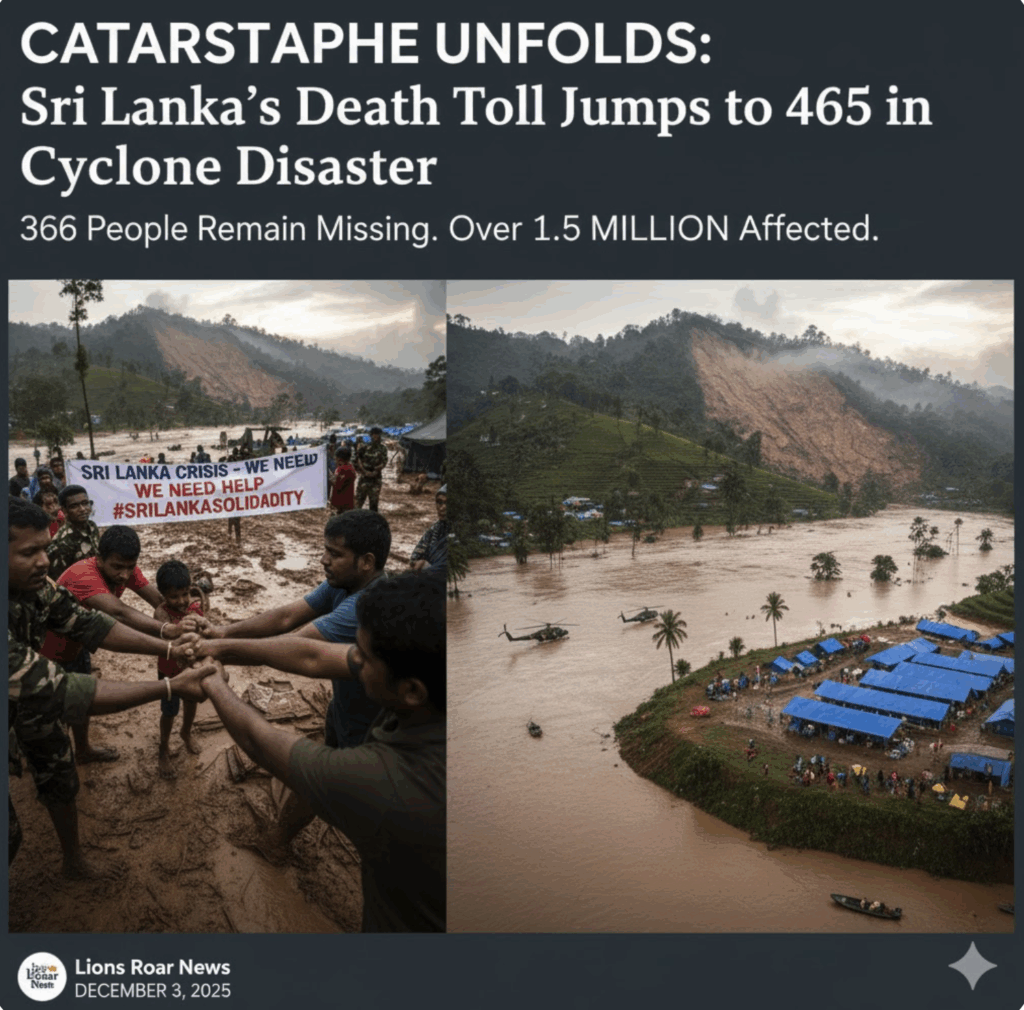
COLOMBO – December 3, 2025 – Sri Lanka is reeling from a humanitarian disaster of catastrophic proportions as the death toll from the relentless floods and landslides triggered by Cyclone Ditwah has soared to an alarming 465, with hundreds more still missing. The latest figures, released by the Disaster Management Centre (DMC) at 6:00 PM yesterday (December 2nd), paint a grim picture of the widespread devastation, revealing that a staggering 366 individuals remain unaccounted for as search and recovery efforts are severely hampered by the sheer scale of the destruction.
The country, already grappling with deep economic challenges, has been plunged into a state of national crisis. The effects of the extreme weather, which has been described as the worst natural disaster to hit the island nation since the 2004 Indian Ocean Tsunami, have affected over 1.5 million people across all 25 districts. The DMC report states that a colossal 1,558,919 individuals belonging to 437,507 families are now classified as affected, many of whom have been displaced, lost their homes, or had their livelihoods completely destroyed.
The Epicentre of Tragedy: Central Highlands Bear the Brunt
While the entire island has felt the devastating touch of Cyclone Ditwah—which unleashed record rainfall, triggering flash floods, dam breaches, and widespread infrastructure collapse—the central highlands, the heart of Sri Lanka’s revered tea country, have emerged as the epicentre of the tragedy. Landslides, a cruel and swift killer, have turned once mist-draped tea mountains into what some media have chillingly termed a ‘death valley.’
The worst-hit district is Kandy, which alone accounts for 118 confirmed deaths and a distressing 171 missing persons. The search for survivors and victims in this rugged, inaccessible terrain is a monumental task. Rescuers, comprising local volunteers, military personnel, and international aid teams, are battling treacherous mud and debris, often in areas where entire slopes have been sheared away, leaving huge, ochre scars across the landscape.
- Kandy: 118 dead, 171 missing
- Nuwara Eliya: 89 dead, 73 missing
- Badulla: 83 dead, 28 missing
- Kurunegala: 53 dead, 27 missing
- Kegalle: 22 dead, 48 missing
In districts like Nuwara Eliya and Badulla, where 89 and 83 deaths have been recorded, respectively, the situation remains precarious. Road access to many interior areas remains cut off, forcing the continuous deployment of military, Indian, and Pakistani helicopters to evacuate the sick, rescue tourists, and ferry vital supplies like water, dry rations, and medical aid to marooned residents. The fear is palpable: as rescue teams gain access to further isolated communities, the total fatality figure is expected to climb even higher.
🌊 The Struggle for Survival: Over 1.5 Million Affected
The humanitarian crisis extends far beyond the soaring death toll. The sheer number of displaced and affected citizens underscores the overwhelming challenge facing the nation’s emergency services and government. As of the latest update, over 232,000 individuals have been forced to seek shelter in 1,433 safe camps established across the country, their homes either completely destroyed or rendered uninhabitable.
The impact on housing is devastating:
- 783 houses have been completely destroyed.
- An additional 31,417 residences have sustained partial damage.
Survivors’ accounts speak of the terrifying speed of the disaster. In low-lying areas, residents along the banks of major rivers like the Kelani were caught unaware as waters rose with unprecedented rapidity. The capital, Colombo, itself experienced severe flooding, though Irrigation Department officials now report that major rivers have receded to normal levels, bringing a small measure of relief to the metropolitan area.
A 74-year-old resident from Biyagama, Siriyalatha Adhikari, shared her ordeal: “We didn’t have time to remove anything from the house. Everything happened so fast. Our whole house was under water, we didn’t think it would flood so quickly.” This sentiment is echoed by hundreds of thousands who lost not only their homes but all their possessions, now forced to rebuild their lives “from scratch.”
🌍 A Call for Global Solidarity: International Aid Pours In
In the face of what President Anura Kumara Dissanayake has called “one of the worst [disasters] in the country’s history,” the Sri Lankan government has declared a state of emergency and issued an urgent appeal for international aid.
The response from the global community has been swift and crucial. Neighbouring India launched ‘Operation Sagar Bandhu,’ providing urgent search, rescue, and Humanitarian Assistance and Disaster Relief (HADR) support. Over 53 tonnes of relief material have been delivered via air and sea, including essential supplies for displaced families. Pakistan has also contributed actively, deploying helicopters and rescue teams to assist in the difficult, high-altitude operations in the Central Highlands.
- Military and Volunteer Effort: Thousands of police, military personnel, and local villagers are engaged in round-the-clock operations, distributing food, clearing debris-choked roads, and moving trapped families to safety.
- Civil Society Response: Media institutions, voluntary organisations, and private sector entities have stepped up with massive relief efforts, collecting and distributing food and non-food items to welfare centres. Church institutions, often the first to open their doors, have become crucial safe havens for the displaced.
- Government Relief: Recognising the severe financial burden on affected families, the government has announced an increase in the allowance paid to clean up damaged houses. The proposed allowance has been significantly raised from Rs 10,000 to Rs 25,000, with a critical amendment that the aid will be disbursed irrespective of house ownership, ensuring broader access to immediate financial relief. Furthermore, the establishment of the ‘Rebuilding Sri Lanka’ Fund has been approved by the Cabinet, with representatives from both the public and private sectors appointed to its management committee, signalling a concerted effort to manage the immense rebuilding task ahead.
The Long Road Ahead: Health, Environment, and Reconstruction
While the immediate focus remains on search, rescue, and providing basic necessities to the displaced, the long-term challenges are only just beginning to emerge.
Health Concerns: The United Nations Office for the Coordination of Humanitarian Affairs (OCHA) has warned that the widespread flooding is putting an immense strain on the country’s already fragile health system. Several district hospitals have been flooded, and the risk of food-borne, water-borne, and vector-borne diseases is alarmingly high. Authorities are urging the use of safe drinking water and strict food hygiene practices to prevent a secondary health crisis.
Environmental Damage: The massive landslides have stripped away entire swathes of forest cover and agricultural land, particularly in the tea country, raising serious questions about the region’s environmental future and the long-term stability of the remaining slopes. The loss of crops and livestock also spells an economic disaster for the affected farming communities.
Reconstruction and Preparedness: The devastation caused by Cyclone Ditwah serves as a stark, unavoidable reminder of Sri Lanka’s vulnerability to extreme weather events. Experts and citizens alike are calling for an immediate, comprehensive review of disaster preparedness, early warning systems, and land-use planning, especially in landslide-prone areas. The immediate crisis demands relief, but the path to long-term recovery must include robust measures to “build back better” and protect the population from future climate-related catastrophes.
🙏 A Nation Grieves, A Nation Responds
The figures released by the Disaster Management Centre—465 dead, 366 missing, over 1.5 million affected—are not just statistics; they represent the heart-wrenching loss of life, the separation of families, and the utter destruction of homes and livelihoods. Every citizen’s story is one of trauma, resilience, and the sheer effort of surviving the elements.
From the villages of Kandy to the urban slums of Colombo, the grief is deep, yet so is the spirit of national unity and solidarity. The tragedy has brought to the forefront the enduring, compassionate character of the Sri Lankan people, with ordinary citizens working shoulder-to-shoulder with military and international teams to pull their nation back from the brink.
As the heavy rains subside and the monumental task of recovery begins, the world watches. Sri Lanka stands at a critical juncture, facing one of its greatest challenges in decades, one that will test the resilience of its people and the depth of its domestic and international support. The journey to recovery will be long and arduous, but the concerted efforts underway offer a fragile but necessary glimmer of hope in the shadow of this immense tragedy.