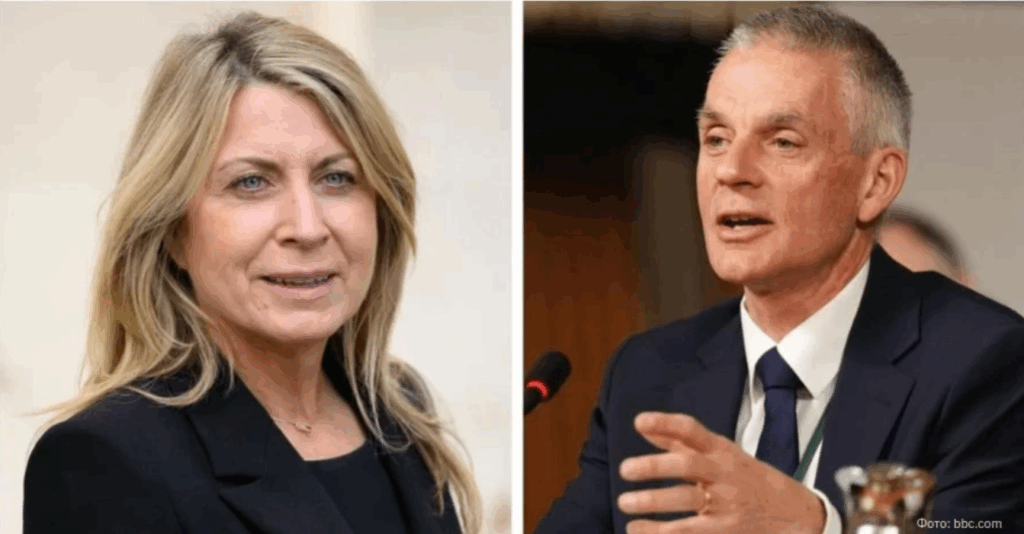
MEDIA SHOCKWAVE: BBC Director-General Tim Davie and News Chief Deborah Turness Resign Amid Trump Editing Scandal
By Lions Roar News Global Media & Politics Bureau
LONDON, UK — The venerable British Broadcasting Corporation (BBC) was plunged into institutional crisis on Monday as two of its most senior executives, Director-General Tim Davie and BBC News Chief Deborah Turness, abruptly resigned from their positions. Their simultaneous departure stems from a widening, politically charged scandal concerning the alleged controversial editing and potential misrepresentation of a discussion involving US President Donald Trump within a recent BBC documentary.
The resignations, confirmed by official statements released late yesterday, follow weeks of intense public and internal scrutiny after allegations surfaced that sections of a documentary featuring an interview or discussion with President Trump had been manipulated or selectively edited. While the BBC initially defended the production, the swift exit of its top leadership suggests that the internal fallout from the controversy had become unmanageable.
Tim Davie, who had steered the public broadcaster through previous political and financial storms, and Deborah Turness, a seasoned news executive brought in to revitalize BBC News, both confirmed their immediate resignations. The reasons cited in their initial departure notes alluded to the need to “restore public confidence” and allow the Corporation to move forward “without distraction” following the high-profile uproar.
The Political Firestorm: Trump’s Reaction
The most significant and immediate reaction came from the centre of the storm: US President Donald Trump. Responding to the resignations via his social media platform, President Trump claimed victory and offered a scathing indictment of the departed executives.
He directly attributed their resignations—or, as he put it, their being “removed or fired”—to the alleged manipulation of his comments regarding the January 6th Capitol riot.
“The highest people at the BBC are being removed or fired… because they distorted my very good speech on January 6th,” Trump stated, adding a further accusation: “These are very dishonest people who tried to weigh in on a Presidential Election, and what a terrible thing this is for Democracy.”
Trump’s comments reference a long-running narrative where he and his allies have accused major Western media outlets, including the BBC, of exhibiting a profound bias against him. The specific focus on the January 6th events suggests the documentary may have selectively presented his remarks about the attack, potentially downplaying his condemnation or focusing entirely on controversial elements, thereby fueling his long-standing grievances against the media.
The Institutional Crisis at the BBC
The BBC, funded by a public license fee and mandated to maintain strict political impartiality, views any allegation of editorial manipulation with the utmost severity. This incident touches upon two critical vulnerabilities: editorial integrity and political independence.
For Davie and Turness, the controversy came at a time when the BBC was already under intense pressure from the UK government and right-leaning media critics who frequently accuse the Corporation of liberal bias. The resignation of both the Director-General and the head of news is an unprecedented institutional acknowledgment of a catastrophic failure in editorial control, signaling that the incident was judged to be a fundamental breach of trust.
Media analysts suggest that the internal investigation must have uncovered evidence confirming, at the very least, a lapse in judgment or a gross deviation from established editorial standards in the documentary’s editing process. The scale of the leadership exit suggests that the controversy was not merely a political difference of opinion but a substantive issue of fact manipulation.
“The BBC is founded on trust,” explained Dr. Eleanor Vance, a media ethics professor at the London School of Economics. “When the Director-General and the Head of News both step down over an editing issue, it’s a profound signal that the core contract with the public has been violated. The implication is that the alleged distortion of a high-profile political figure’s words was seen as a foundational mistake that risked the entire institution’s credibility, especially in the context of an ongoing US election cycle.”
The Road Ahead
The immediate future for the BBC is one of uncertainty and an urgent need for damage control. The Corporation’s Board of Governors will immediately initiate a search for replacements, a process that is likely to be highly politicized given the nature of the resignations. The new leadership will face the monumental task of not only maintaining the BBC’s output but also restoring the global reputation for neutrality that has now been severely damaged by the Trump controversy.
Furthermore, the incident provides fresh ammunition for those who advocate for dramatic reforms to the BBC’s funding structure, including abolishing the license fee. Critics will argue that a publicly funded body that fails to uphold strict impartiality undercuts its own justification for mandatory public funding.
The controversy is a stark reminder of the heightened stakes in global political reporting, where every editorial decision is scrutinized through the lens of political alignment. For the BBC, the price of this editorial lapse has been the immediate loss of its two top leaders and a painful reckoning with its most sacred value: journalistic honesty. The coming months will determine if the BBC can weather this profound institutional shock and successfully rebuild the public trust that has been so visibly broken.