Coastal Alert: Sri Lanka Launches Major Tsunami Drill Under UNESCO Guidance; Public Cautioned Against Panic
By The Lion’s Roar News International Desk
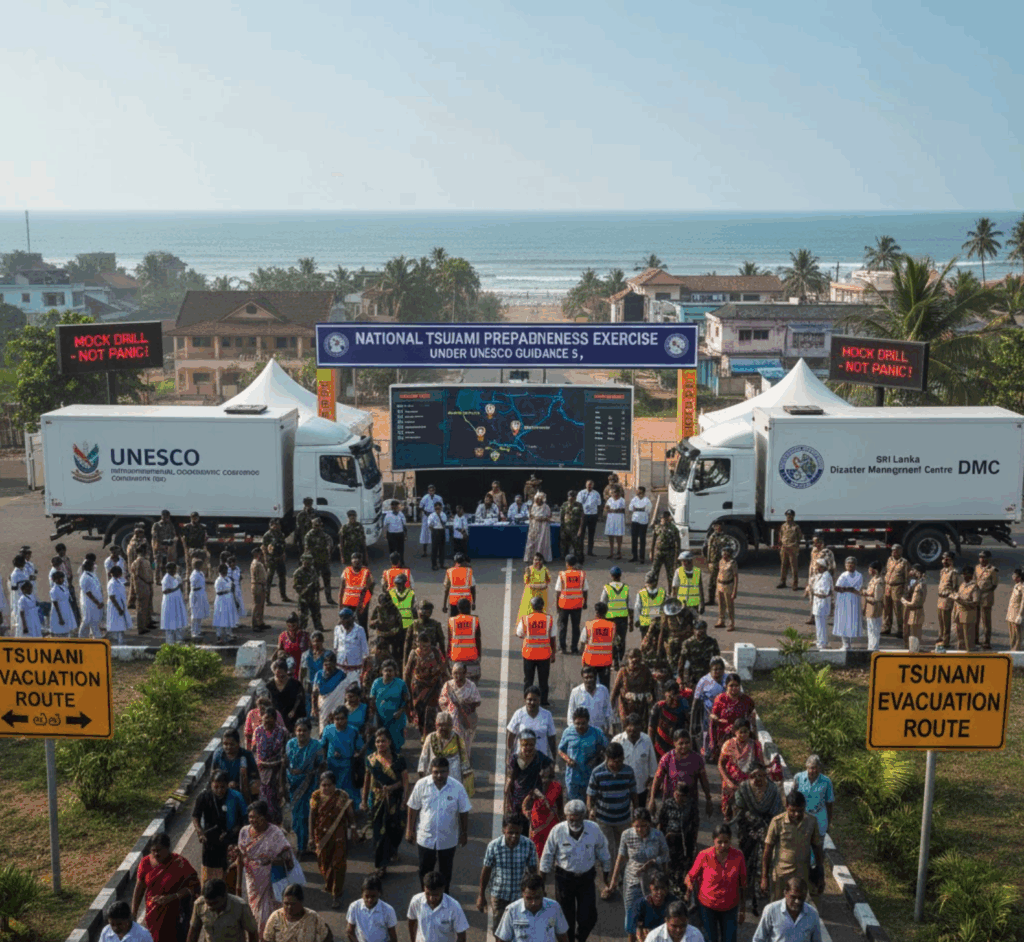
COLOMBO—Sri Lanka’s Disaster Management Centre (DMC) is set to execute a major Indian Ocean Tsunami preparedness exercise this Wednesday, November 5, coinciding with the annual Tsunami Awareness Day. The nationwide simulation, designed to test the country’s readiness for a catastrophic wave event, will involve thousands of participants across four coastal districts, but the DMC has issued an urgent public appeal: do not panic or harbor undue fear, as the event is a pre-scheduled mock drill.
The initiative, formally classified as a Special Preparatory Exercise conducted under the official guidelines of UNESCO, underscores Sri Lanka’s commitment to strengthening its national disaster response mechanisms in the wake of the devastating 2004 Indian Ocean Tsunami, which claimed over 35,000 lives across the island.
Testing the National Tsunami Protocol
The core objective of the exercise is to evaluate the seamless transition of information and action across all levels of government—from national early warning centers down to grassroots Grama Niladhari (GN) division officials and coastal communities. This drill aims to ensure that communication channels are clear, evacuation routes are understood, and the designated safe zones are efficiently utilized.
The DMC emphasized that this is purely an internal, practical training program and not indicative of any current threat. The main national rehearsal is scheduled to commence at 8:30 AM in the Kalutara District, which will serve as the primary focus area for the synchronized execution of the simulation protocols.
The scope of the practical drill extends beyond Kalutara, incorporating five specially selected Grama Niladhari divisions across three other vital coastal districts: Batticaloa (East), Jaffna (North), and Galle (South). By staging the exercise across diverse geographical regions and community structures, authorities seek to identify specific regional challenges, such as varying population densities, infrastructure limitations, and localized communication gaps. The participation of schools and local hotels in these areas is particularly crucial, as they represent high-density zones where rapid and orderly evacuation is paramount to saving lives.
Multi-Agency Mobilization for Preparedness
The drill’s success hinges on massive inter-agency cooperation. The preparedness exercise will see the mobilization and coordination of an extensive network of governmental, security, and civic organizations. Key participating stakeholders include:
- The Disaster Management Centre (DMC)
- The Department of Meteorology (The official warning authority)
- The Ministry of Education (Ensuring schools are integrated into evacuation plans)
- The Ministry of Health (Coordinating casualty response and medical preparedness)
- District and Divisional Secretariats (The administrative backbone of local mobilization)
- The Sri Lankan Tri-Forces (Army, Navy, and Air Force) and the Police (For security, traffic control, and enforcement of evacuation)
- The National Disaster Relief Services Centre
- Local Government Institutions
- Schools and educational institutions
- The Tourism Sector (including coastal hotels)
This vast assemblage of participants highlights the complex logistical challenge of a genuine large-scale disaster response and the critical need for a unified command structure.
The Contingency: What if a Real Tsunami Hits During the Drill?
A key component of the DMC’s public announcement was the detailed contingency protocol should a genuine tsunami event be detected during the exercise window. Authorities stressed that if a real tsunami threat materializes, the practical training program will be immediately halted.
In such a scenario, the established national protocols and operational procedures between the Department of Meteorology and the DMC will be instantly activated. This rapid transition would involve the deployment of official national tsunami warning responses, ensuring the public is informed through verified, authoritative channels and immediately directed to pre-identified safe locations and assembly points. This assurance is vital to prevent confusion between the simulated and a real-life threat.
The exercise ultimately serves as a necessary, sobering practice, ensuring that the hard-learned lessons from the tragedy of 2004 are not forgotten and that Sri Lanka’s response capacity is continually sharpened. The DMC urges the public in the designated areas to observe the drill with cooperation, recognizing it as an essential investment in the safety of future generations.