140 New Hospital Beds to be Fast-Tracked in Major Capacity Boost
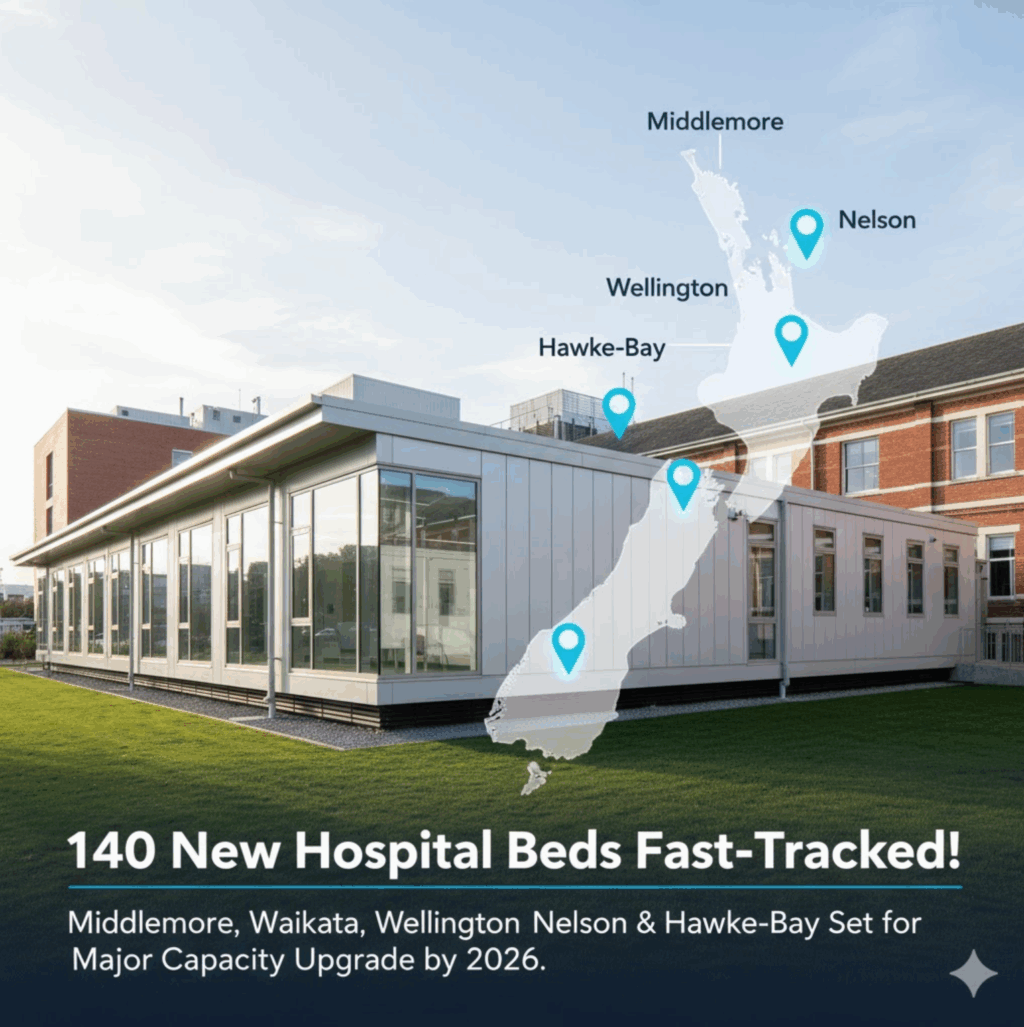
WELLINGTON – The New Zealand health system is set for a significant injection of capacity with the Government today announcing a rapid-build programme that will deliver 140 new hospital beds across five key regions by the second half of 2026.
Health Minister Simeon Brown confirmed the ambitious plan, which utilises modular, off-site construction to bypass lengthy traditional build timelines. The new wards are set for deployment at Middlemore, Waikato, Wellington Regional, and Nelson Hospitals, opening concurrently with a previously announced new ward at Hawke’s Bay Hospital.
“These new wards will make a real difference for both patients and staff,” Minister Brown stated. “They will ease pressure on emergency departments, support faster admissions and discharges, and improve patient flow right across the hospital.”
Rapid-Build Strategy to Tackle Bed Block
The “rapid-build” approach marks a shift in how the government is addressing New Zealand’s persistent hospital capacity crunch and the issue of “bed block”—where admitted patients are stuck in Emergency Departments (EDs) due to a lack of available ward beds.
The modular units are constructed off-site and then installed directly onto hospital grounds, a method the Minister noted has a design life of up to 50 years and offers flexibility for future clinical demands. This strategy was initially part of the Government’s Budget 2025 commitment to deliver at least three new modular units, with a competitive procurement process allowing a fourth unit to be added, alongside the Hawke’s Bay project.
While the modular units represent a comparatively short-term fix, the Minister stressed they are crucial enablers for longer-term infrastructure investment. Major, multi-year rebuilds are currently underway or planned for Wellington, Nelson, Whangārei, and Dunedin, and these relocatable wards will ensure services can continue uninterrupted during construction.
Targeted Relief for Overwhelmed Regions
Each of the five new wards has been strategically placed to address specific bottlenecks and acute needs in its respective region:
- Middlemore Hospital: The new ward is explicitly designed to expand general medicine capacity, with the goal of relieving immense pressure on the busy Emergency Department and helping the hospital meet the critical target for shorter stays in ED.
- Waikato Hospital: This unit will function as an assessment and diagnostic area located near the ED. It is intended to provide brief observations and treatment, redirecting patients who do not require full inpatient admission away from main wards.
- Wellington Regional Hospital: The capital’s hospital, which has faced significant infrastructure challenges, will see its ward expand in-patient capacity to support acute flow. This will involve caring for lower-acuity patients, freeing up higher-acuity beds, and helping to achieve the shorter stays in ED target—a particular focus for the region.
- Nelson Hospital: The new ward here plays a dual role: initially enabling services to be relocated while essential seismic strengthening is carried out on existing buildings. Once that work is complete, the unit will transition to provide much-needed additional inpatient capacity until the full new inpatient tower is constructed as part of its multi-billion-dollar redevelopment.
- Hawke’s Bay Hospital: This ward, announced earlier in the year, will focus on short-stay surgical patients and assessments. Its purpose is to streamline care for surgical patients and, crucially, free up surgical and medical inpatient beds that are currently being used for shorter-stay cases.
Photos of a 3D render of the modular wards illustrate a modern, clean design, suggesting a contemporary approach to expanding New Zealand’s aging health infrastructure.
The total of 140 new beds is a tangible step towards mitigating the strain on hospital services nationwide, which have struggled under the weight of rising demand, particularly through successive winter periods. With the five new wards expected to be operational in the latter half of 2026, the challenge for Health New Zealand remains the swift and efficient construction, installation, and, crucially, staffing of these vital new facilities.