ECONOMIC SHOCKWAVE: Trump Announces 100% Tariff on Chinese Goods, Reigniting Trade War with Devastating Market Impact
By The Lions Roar Global Economics Desk
WASHINGTON / BEIJING — Global financial markets were plunged into turmoil today following an aggressive announcement by U.S. President Donald Trump, who declared that the United States will impose an additional 100% tariff on certain goods imported from China, effective next month. This unprecedented escalation signals a full-scale renewal of the trade war between the world’s two largest economies, creating immediate economic uncertainty.
The announcement, delivered via a post on the President’s social media platform, was explicitly framed as a direct retaliation against recent protectionist measures taken by Beijing. President Trump stated that, in addition to the tariff hike, the United States would also implement export controls on critical software to safeguard national security interests.
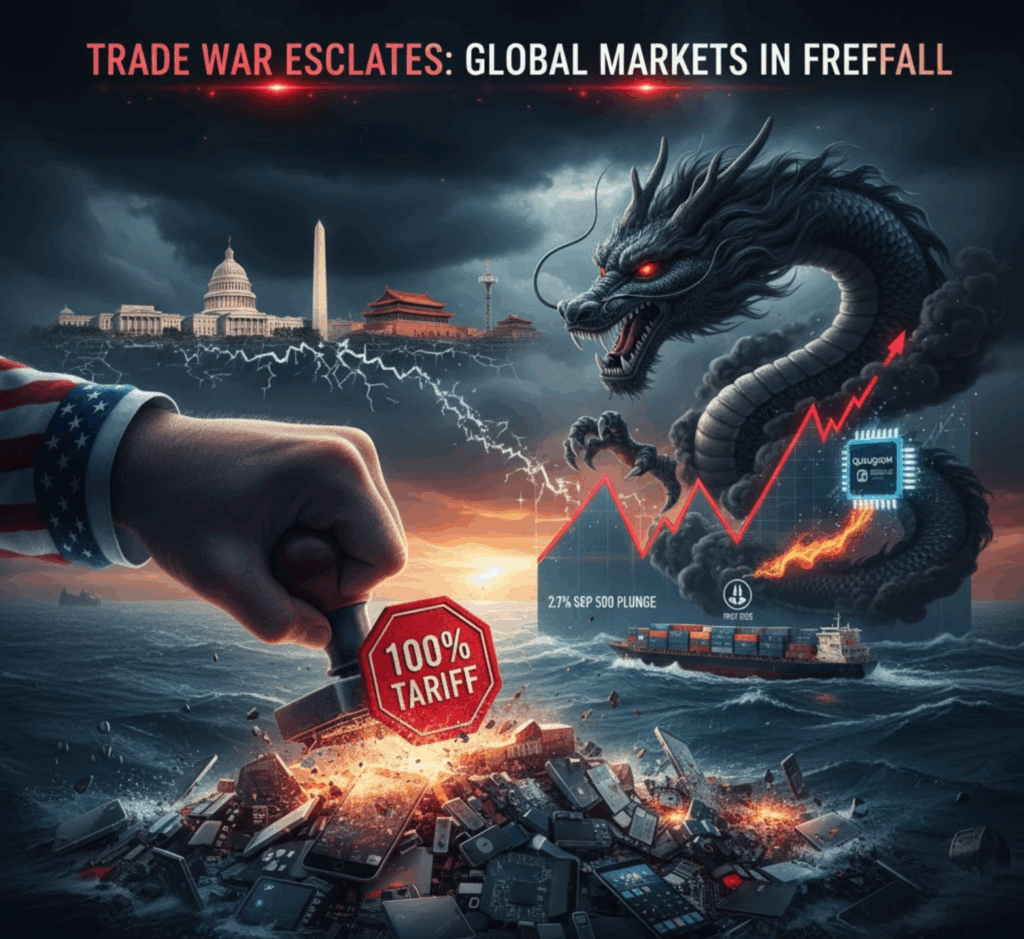
The market reaction was swift and brutal. The S&P 500 Index dropped by 2.7%, marking its steepest single-day decline since April, as investors fled risk assets amid fears of a protracted economic conflict. Asian and European markets quickly followed suit, with manufacturing and technology sectors bearing the brunt of the downturn.
Retaliation Over Critical Minerals
The immediate trigger for the Trump administration’s dramatic move appears to be Beijing’s recent decision to tighten rules and restrictions governing the export of rare earth minerals. These 17 elements are not ‘rare’ in the geological sense, but China controls the vast majority of their global processing and supply. They are indispensable components in high-tech manufacturing, defense systems, electric vehicle batteries, and advanced electronics—making China’s control over them a crucial geopolitical lever.
By tightening export controls on these minerals, China effectively threatened to disrupt the supply chains of U.S. technology and manufacturing companies. The 100% tariff is the Trump administration’s swift and maximalist response, intended to send a clear message about the cost of weaponizing supply chains.
The newly announced tariff is intended to apply broadly to a basket of Chinese goods, though the final list is pending. Analysts expect it to heavily target consumer electronics, machinery, and textiles, sectors that are highly sensitive to price fluctuations and where American alternatives are scarce.
The Counter-Escalation from Beijing
The aggressive moves from Washington have been met by retaliatory actions from Beijing, deepening the cycle of escalation that began earlier this year. The Sinhala text notes that earlier this year, following an initial round of tariff increases by the Trump administration, China had already moved to tighten its own export controls.
Recent retaliatory steps confirmed by reports include:
- Qualcomm Antitrust Probe: China has initiated an antitrust investigation targeting Qualcomm, a major U.S. technology company known for its semiconductor and telecommunications innovations. This move is seen as a direct effort to use regulatory power to impede U.S. corporate interests and may be designed to derail potential future acquisitions of other chipmakers, limiting U.S. expansion in the critical semiconductor market.
- New Port Fees on U.S. Vessels: Beijing has reportedly announced it will impose new port fees on vessels linked to the United States. This includes ships owned or operated by U.S. companies and vessels connected to U.S. interests, constituting a direct attack on international shipping and logistics routes vital for global trade.
These actions underscore that the current conflict is no longer merely about trade deficits but a multi-faceted technological and strategic rivalry centered on controlling future-defining industries like semiconductors, critical software, and rare earth materials.
Market and Industry Exposure
The immediate 2.7% plunge in the S&P 500 reflects deep investor anxiety about corporate earnings and economic growth. Companies reliant on global supply chains and those with high sales exposure in China are set to face significant immediate headwinds.
- Technology Sector: The imposition of U.S. export controls on critical software, combined with China’s action against Qualcomm and its control over rare earths, places the entire U.S. tech sector under duress. Supply chain disruptions will impact production schedules and raise costs for everything from smartphones to data center hardware.
- Manufacturing and Retail: The 100% tariff will double the price of targeted Chinese goods overnight. While U.S. importers may initially absorb some costs, the bulk will inevitably be passed to American consumers, fueling domestic inflation and impacting retail sales ahead of the holiday season.
- Agriculture: Though not directly targeted in the U.S. announcement, history shows that China’s most effective retaliatory tool is often tariffs against U.S. agricultural exports, which could severely damage American farming communities.
The Long-Term Geopolitical Stakes
This trade war escalation is occurring against a tense geopolitical backdrop. Unlike the previous trade conflict, which focused on reducing trade imbalances, the 2025 version is primarily driven by national security and technological supremacy.
By targeting rare earth minerals, China is challenging the U.S. defense industry’s reliance on stable supply chains. By imposing a 100% tariff, the U.S. is pushing for accelerated decoupling—forcing companies to relocate manufacturing out of China and shorten supply chains, a process known as “de-risking”.
The decision to escalate now, with the U.S. electoral cycle potentially looming, also raises the political stakes. Both leaders appear willing to accept substantial short-term economic pain to secure perceived long-term strategic advantages in the global economic hierarchy.
The coming month will be critical, as both nations prepare to implement their respective measures. Governments and central banks worldwide are now bracing for the inevitable spillover effects of this escalating economic warfare on global growth and inflation.