Global Trade Under Siege: Trump’s Tariffs and the Rippling Effects on New Zealand and Sri Lanka
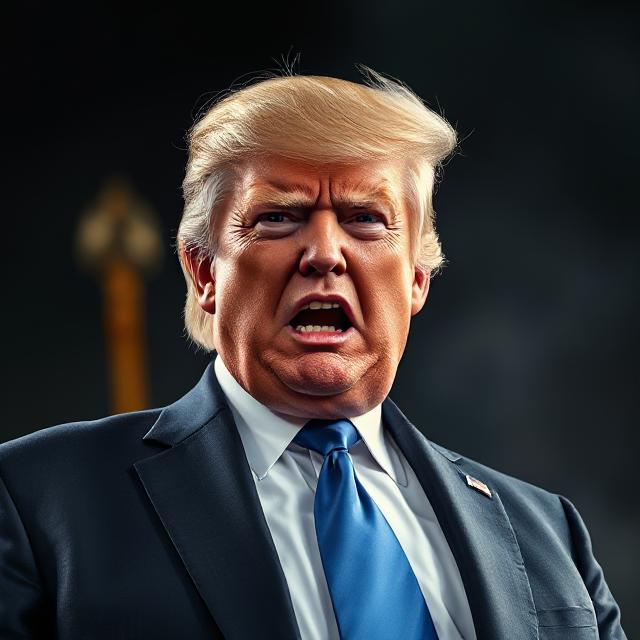
Auckland, NZ – The global economic landscape is bracing for significant turbulence as the administration of U.S. President Donald Trump aggressively implements sweeping tariff changes and new import taxes. These protectionist measures, aimed at recalibrating global trade balances and bolstering domestic industries, are poised to trigger a cascade of consequences, reverberating from major world economies to smaller, export-dependent nations like Sri Lanka and New Zealand. The pragmatic logic behind these tariffs, while seemingly straightforward in its “America First” stance, risks a complex “boomerang effect” that could ultimately harm the very economy it seeks to protect.
President Trump’s renewed push for higher tariffs began to take concrete shape in early April 2025 with a declared “national emergency,” imposing a 10% baseline tariff on most imports, followed by individualized “reciprocal” higher tariffs on countries with which the U.S. has significant trade deficits. This has been further exacerbated by dramatic increases, such as the doubling of steel and aluminum import tariffs to 50%, and threats of even higher levies on various sectors including automobiles and consumer goods. The rationale from Washington is that these taxes will encourage American consumers to buy domestically, increase government revenue, and incentivize “re-shoring” of production. However, early analyses from institutions like the Congressional Budget Office (CBO) and Yale University indicate that while these tariffs may reduce the deficit, they are likely to fuel inflation and shrink the overall size of the U.S. economy, painting a picture of significant uncertainty and instability for global markets.
The repercussions for global trade are profound. The sudden imposition of these tariffs has led to a sharp slowdown in U.S. imports, as companies rush to adjust to the new costs. This disruption impacts global supply chains, creates uncertainty for businesses worldwide, and risks triggering retaliatory tariffs from affected trading partners. While a 90-day pause was briefly introduced for some countries on the higher reciprocal tariffs (excluding China), the underlying threat of escalation remains. This scenario creates a volatile environment where global growth forecasts are being downgraded, and the specter of a full-blown trade war looms large, with potential for widespread economic contraction.

For Sri Lanka, the impact has been particularly acute. With the U.S. imposing a substantial 44% tariff on approximately $3 billion worth of Sri Lankan exports, primarily its vital apparel industry, the island nation faces severe economic strain. This move, a significant departure from previous preferential trade terms, threatens job losses in a sector that employs a substantial portion of Sri Lanka’s workforce. Reduced foreign exchange earnings will further destabilize the rupee, leading to higher import costs, including for essential medical supplies, and potentially straining the public healthcare system. A high-level Sri Lankan delegation, led by Deputy Minister of Finance and Planning Dr. Harshana Suriyapperuma, recently engaged in a second round of crucial discussions in Washington D.C. with the Office of the United States Trade Representative (USTR). While the details of these talks are yet to be fully disclosed, the objective was clear: to explore avenues for enhancing trade cooperation and securing more favourable outcomes in light of Sri Lanka’s pressing economic priorities and the potential for a catastrophic impact on its export-led recovery efforts.
New Zealand, though initially facing a comparatively lower 10% additional tariff on most of its goods exported to the U.S., is by no means immune to the wider implications. While the direct financial hit to export earnings is estimated around NZD900 million annually, representing about 2% of the value of its economy, the indirect effects are far more concerning. Prime Minister Christopher Luxon has strongly condemned the shift away from a rules-based trading system, warning of a “profound shift in the global economic landscape” and the risk of a global trade war. The New Zealand government’s response has been pragmatic: while acknowledging the tariffs are not ideal, it has stated it will not impose retaliatory tariffs, recognizing that such actions would primarily lead to higher costs for its own consumers. Instead, New Zealand continues to advocate for the removal of these tariffs through diplomatic engagement and remains a vocal proponent of free trade agreements, seeking to diversify its export markets and mitigate risks in a highly uncertain global environment.
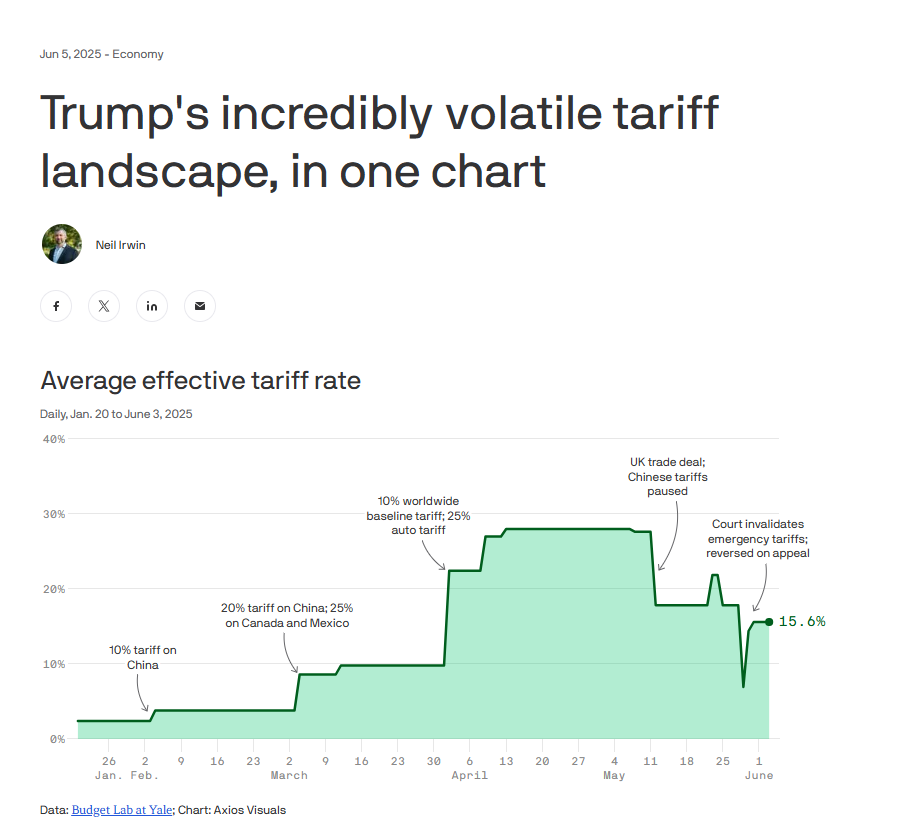
Above graph was abstracted by https://www.axios.com/2025/06/05/trump-tariff-rate-volatility the credit should go to the writer Neil Irvin, It describes the changes of the tariffs since January 2025
Ultimately, the U.S. economy itself faces a significant “boomerang effect” from these protectionist policies. While proponents argue for job creation in specific sectors, studies suggest a net loss of jobs across the broader manufacturing industry due to higher input costs for steel and aluminum. Furthermore, the tariffs are projected to lead to increased inflation and a loss of purchasing power for American households, disproportionately affecting low-income families. The argument that tariffs will generate substantial revenue for the federal budget is also being challenged, as the negative impact on GDP and the resulting decline in the tax base could significantly offset any gains. The instability and uncertainty generated by these trade policies are already deterring investment and could lead to a contraction of economic growth, proving that in an interconnected global economy, no nation operates in a vacuum, and unilateral actions can have far-reaching and often unintended negative consequences at home. Sources